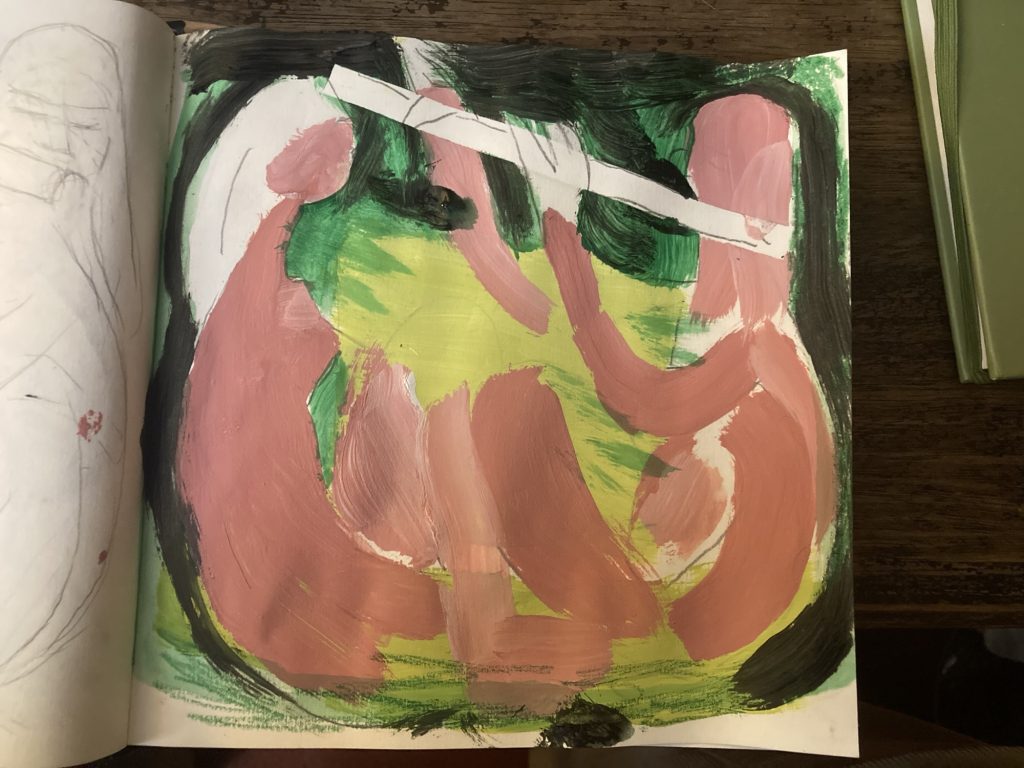
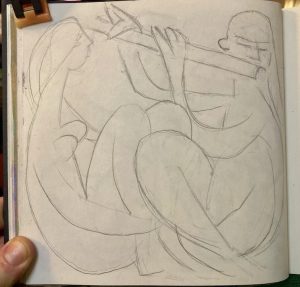
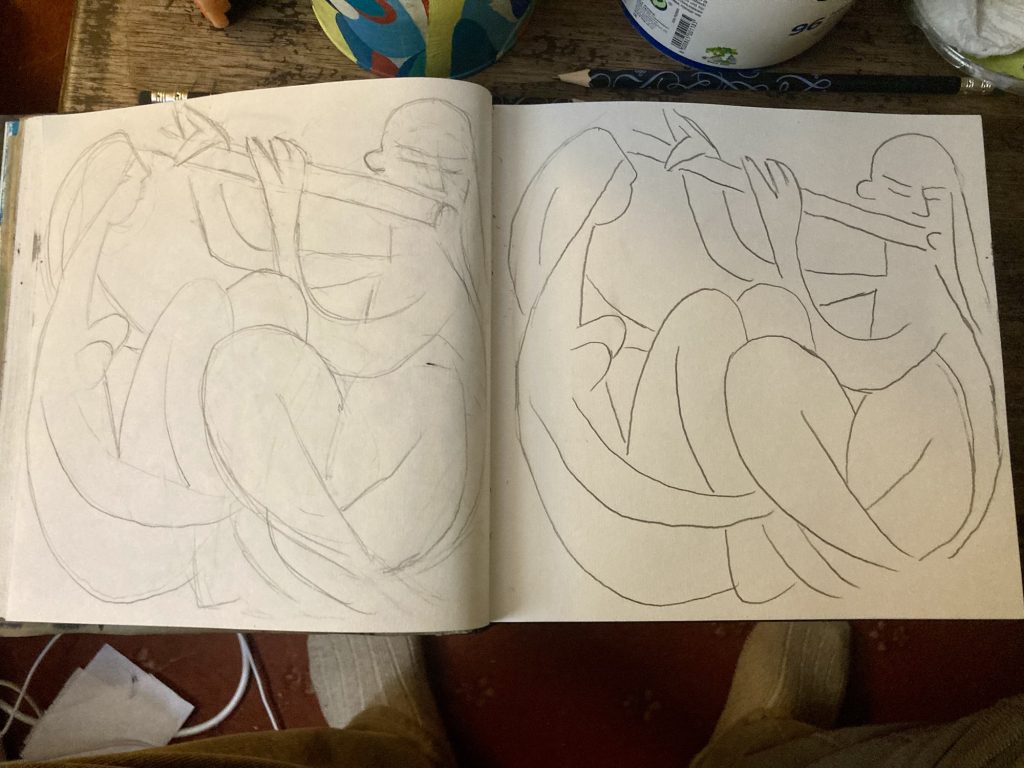
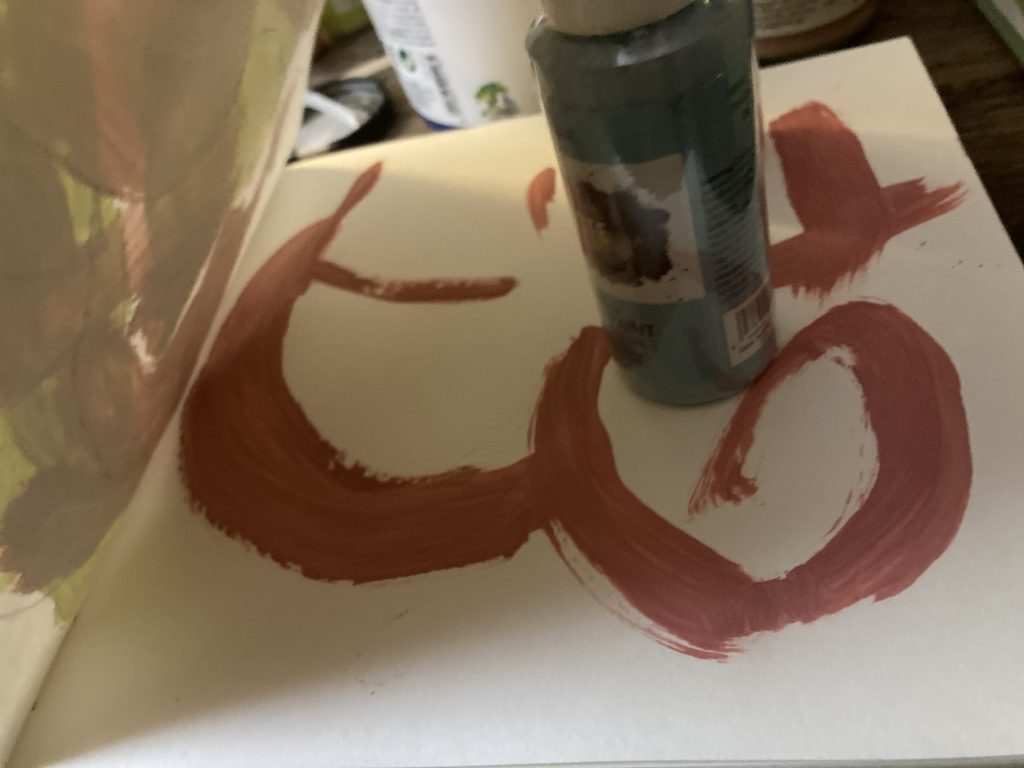
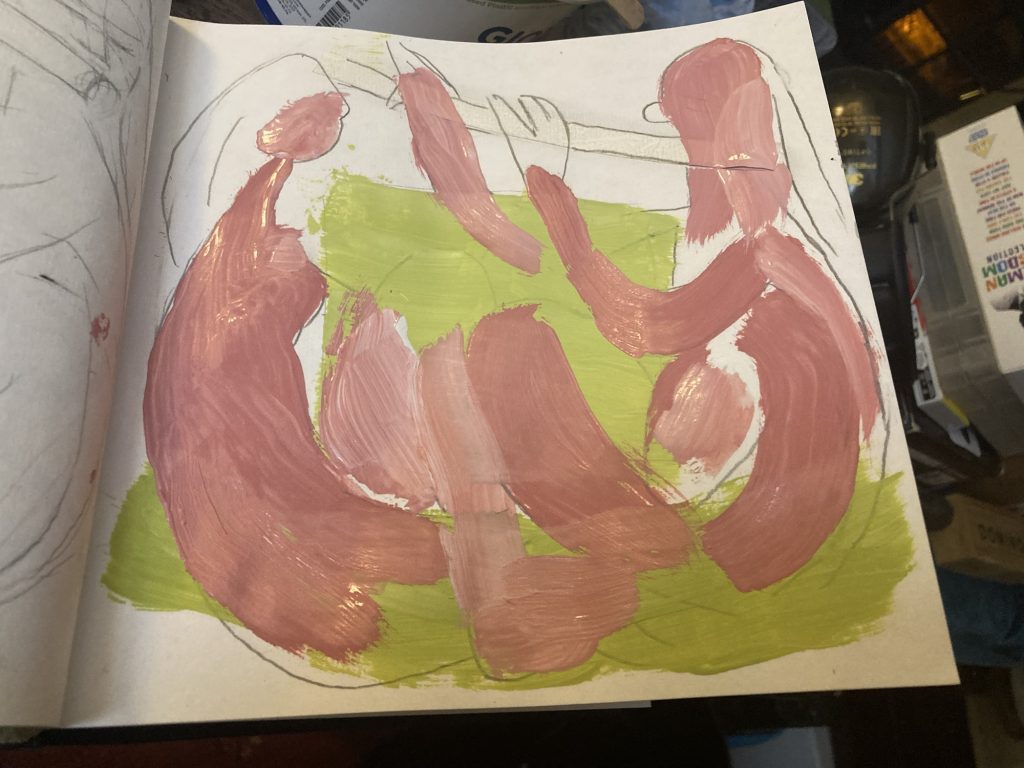
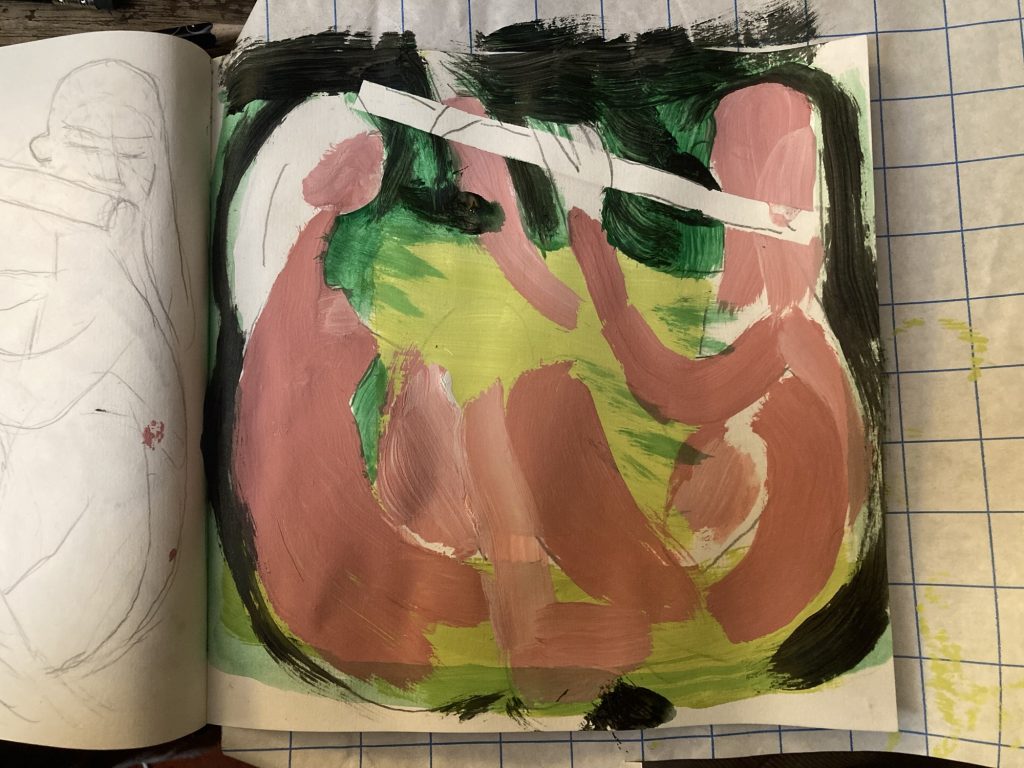
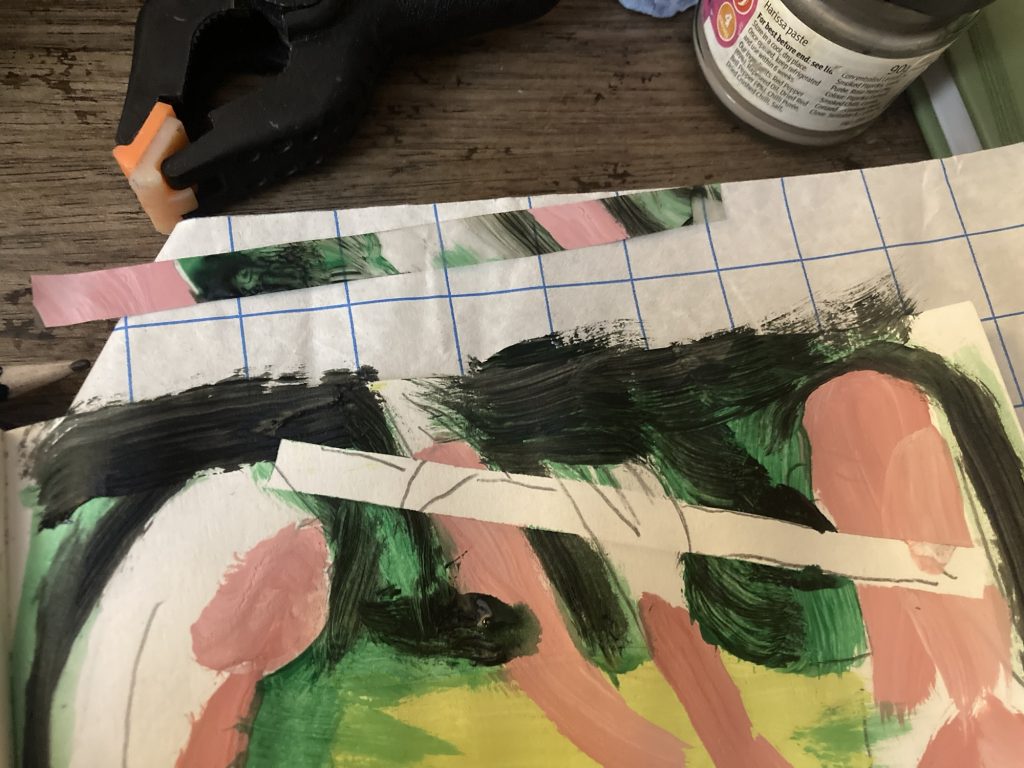
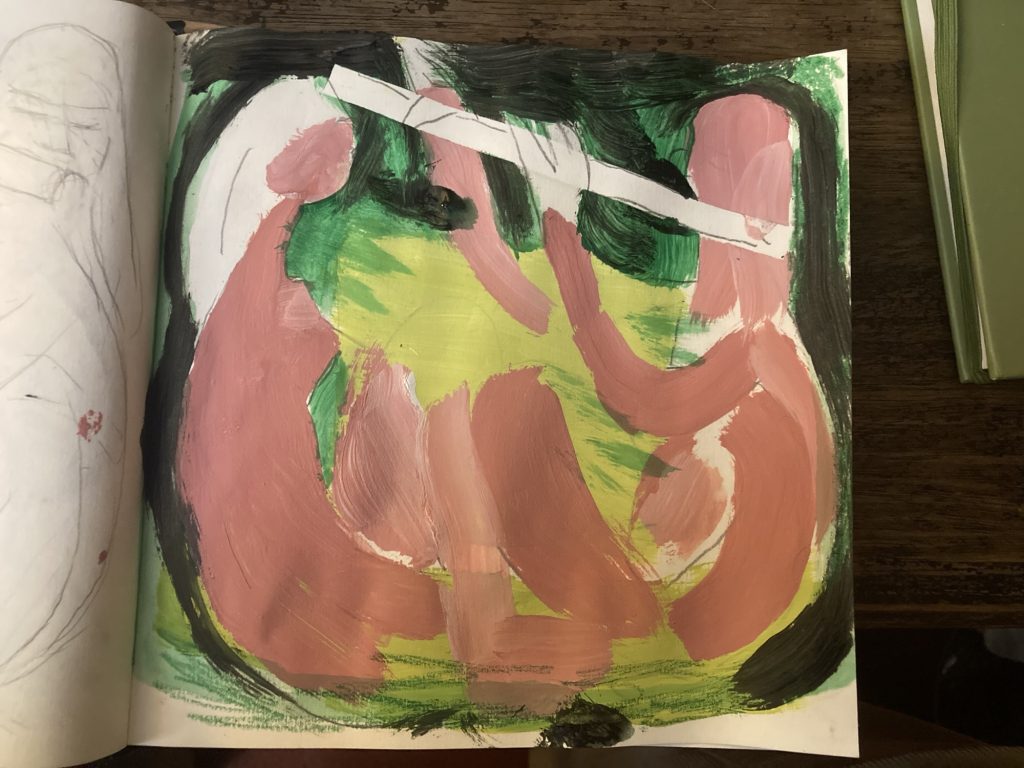
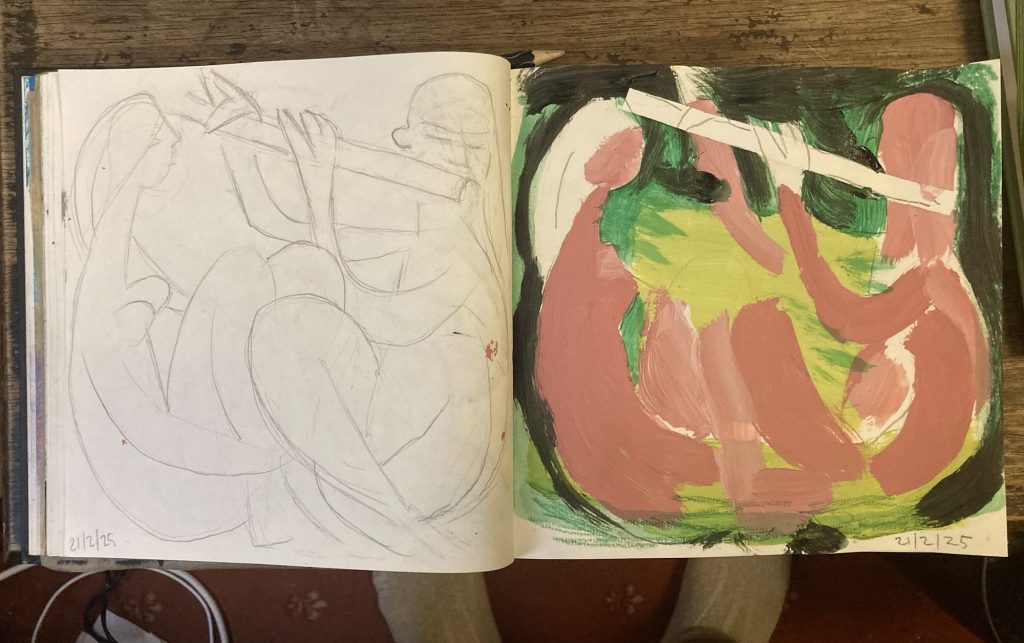
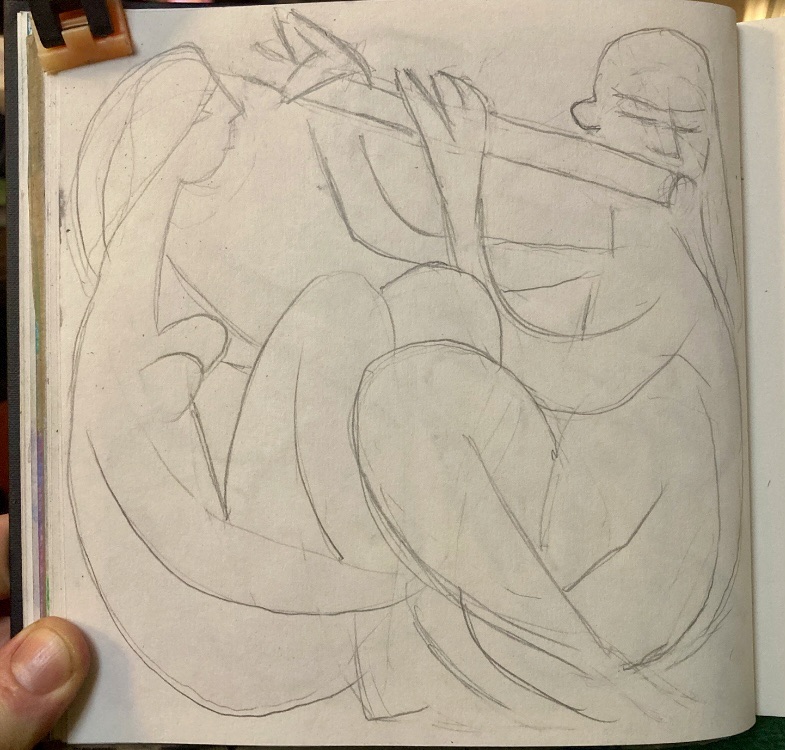
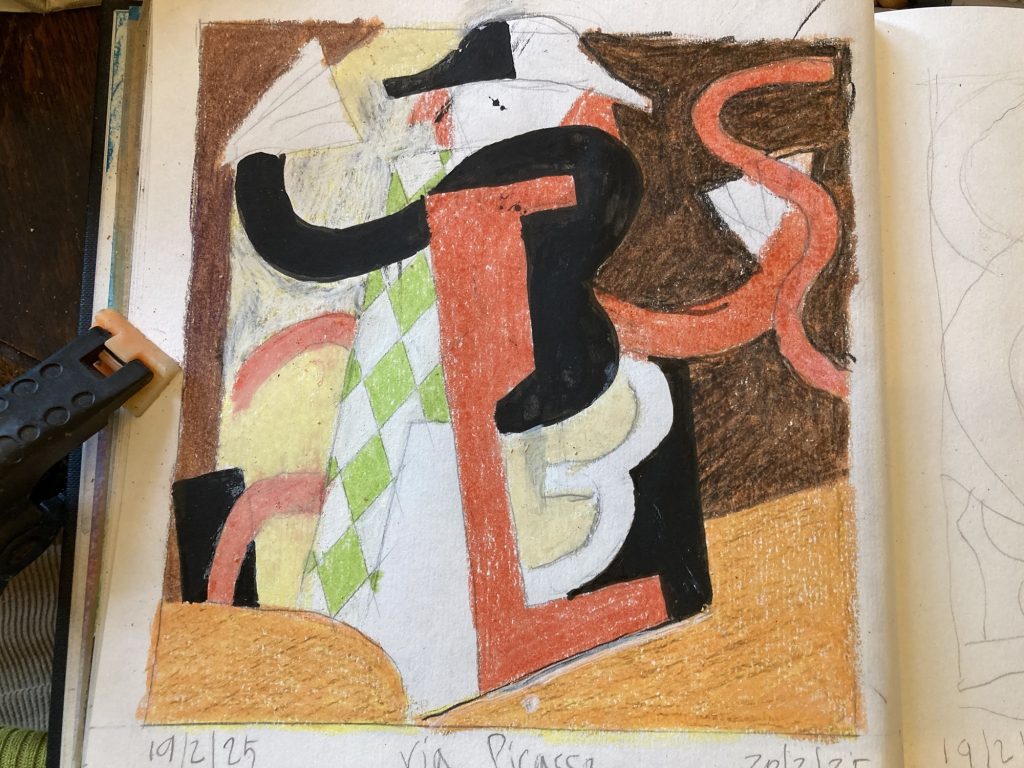
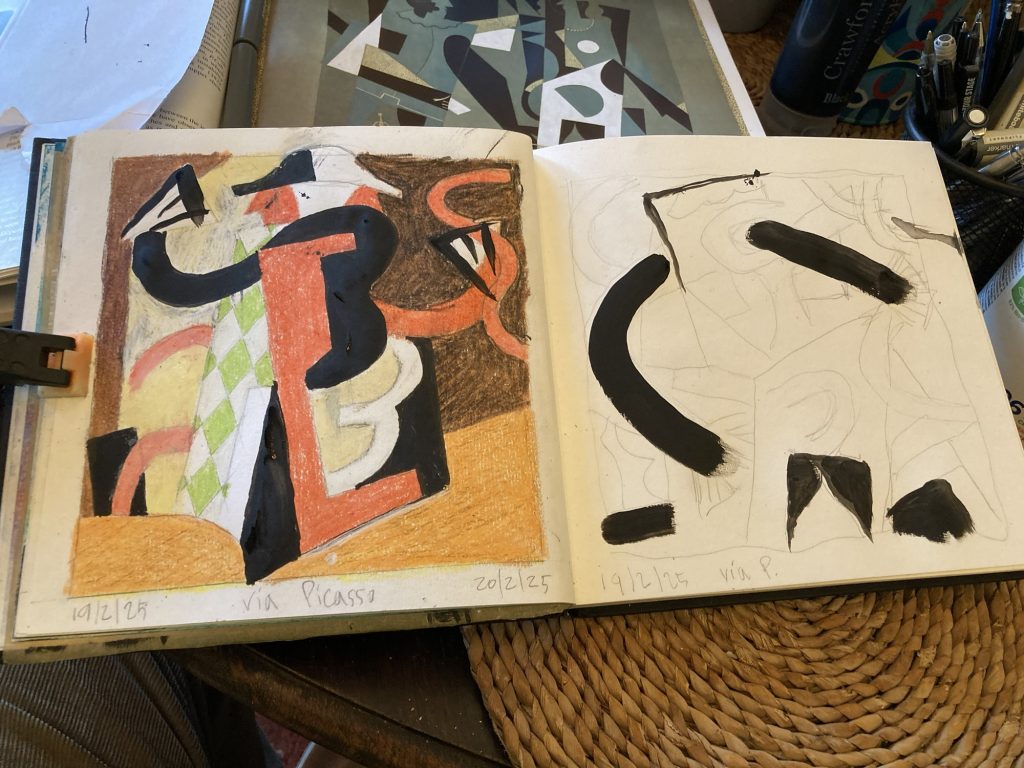
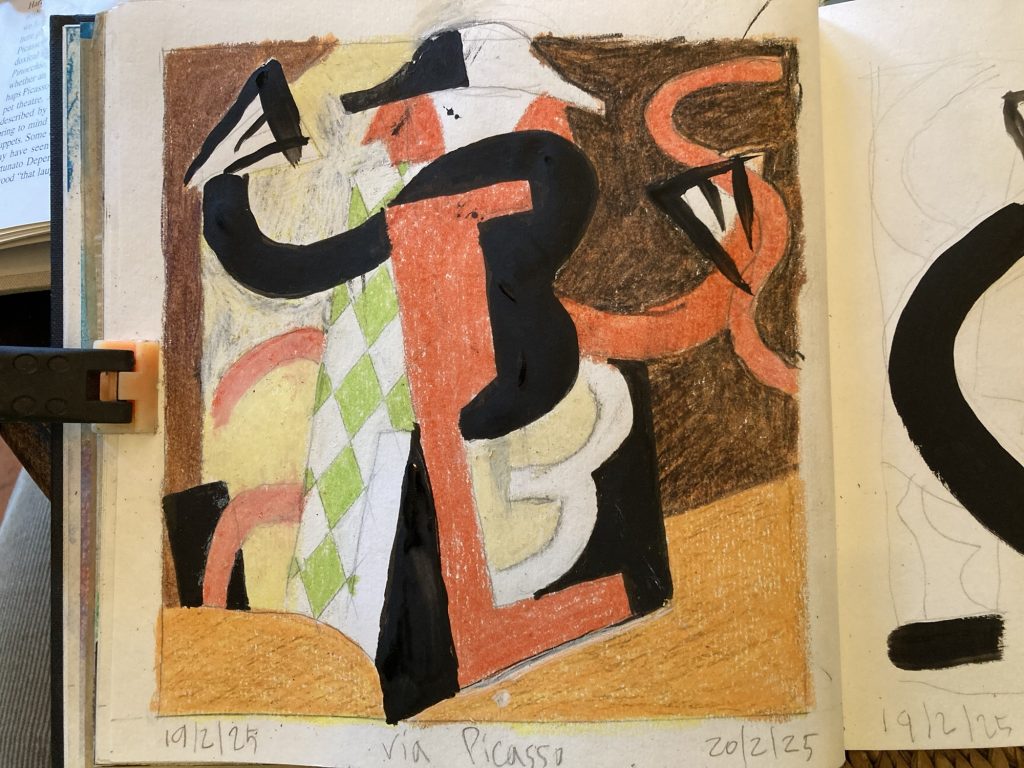
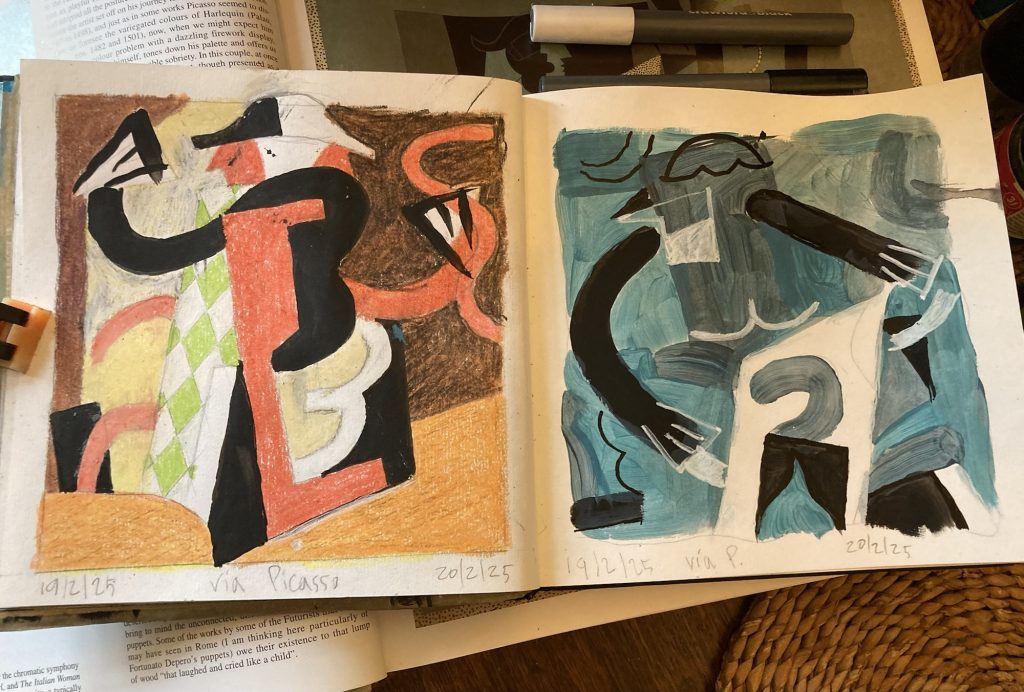
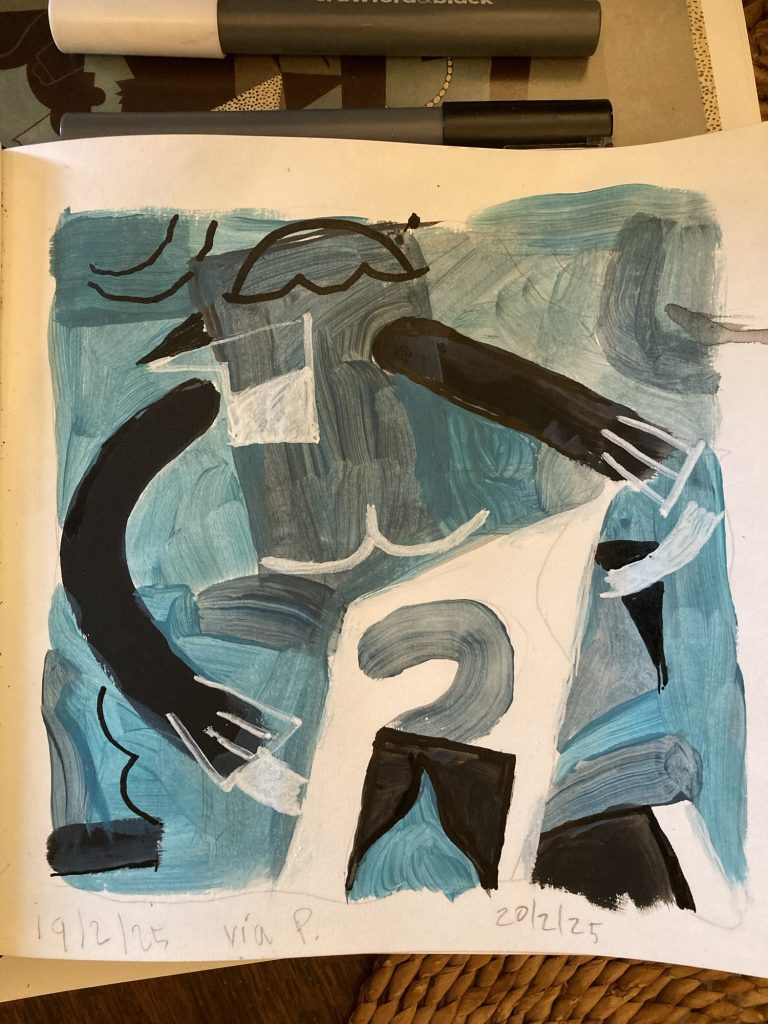
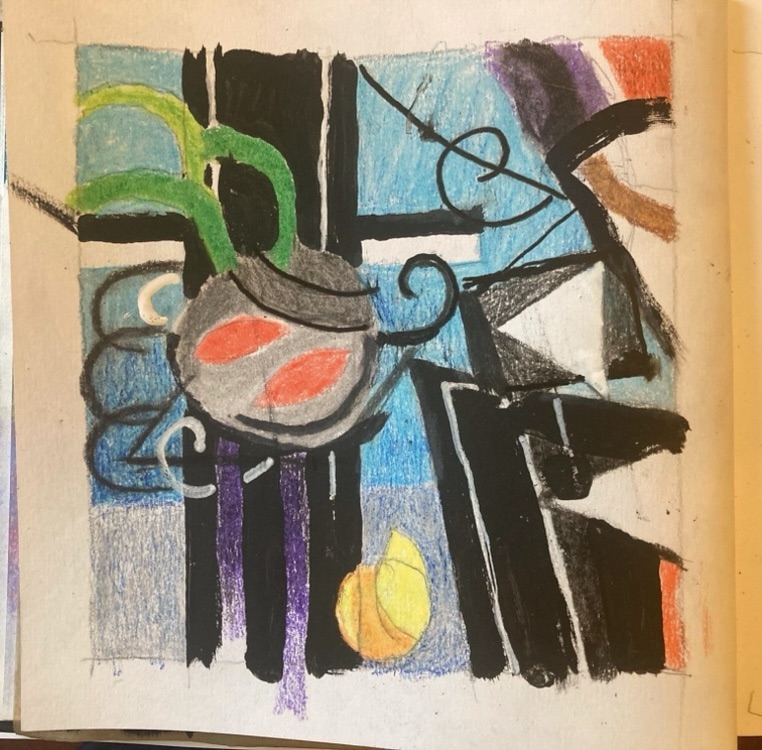
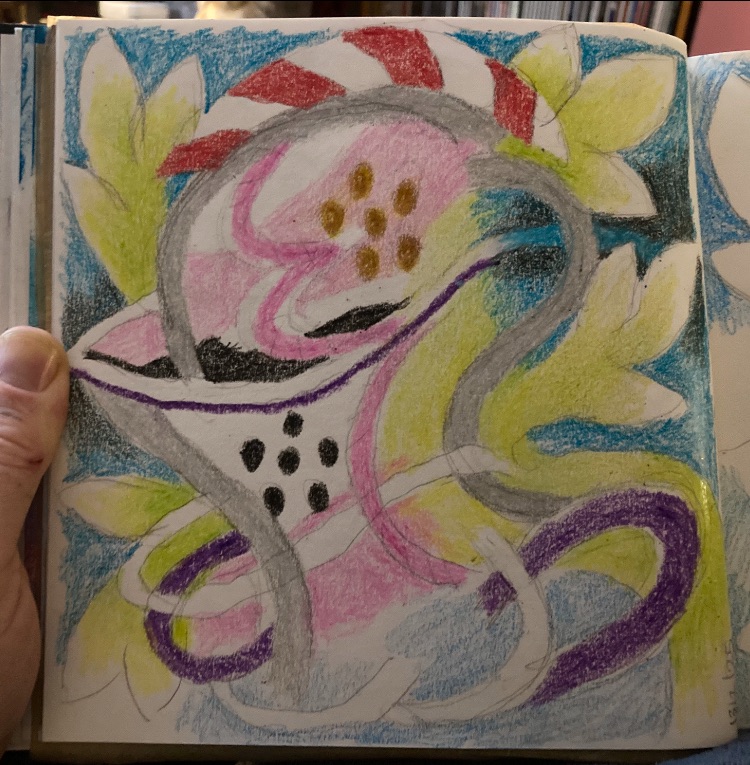
Here’s a gallery of my current WIP, a design for a painting for Dan & Amy. I might well do several other versions. Poss’ explore different colour schemes, etc. We shall see!
First sketch.Transposed for colouring.Using excess paint…Blocking in colours.More colour.Unmasked flute.Added crayon.Close of play.
That’s it for today. Time to turn in. Hope I sleep better tonight. Last night wasn’t fun. Woke about 2:30 am. Ended up getting up/dressed, and sitting downstairs, reading, etc.
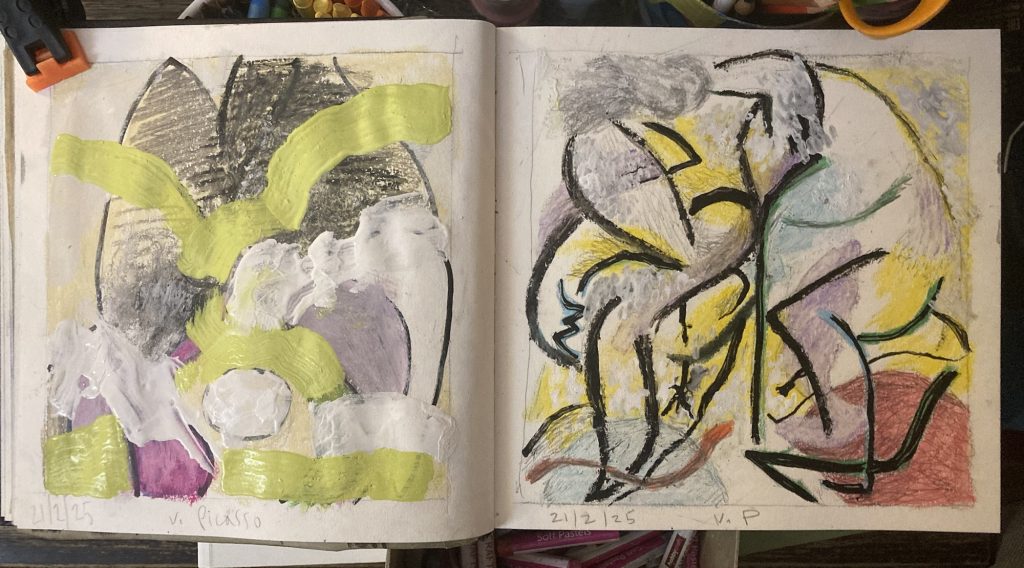
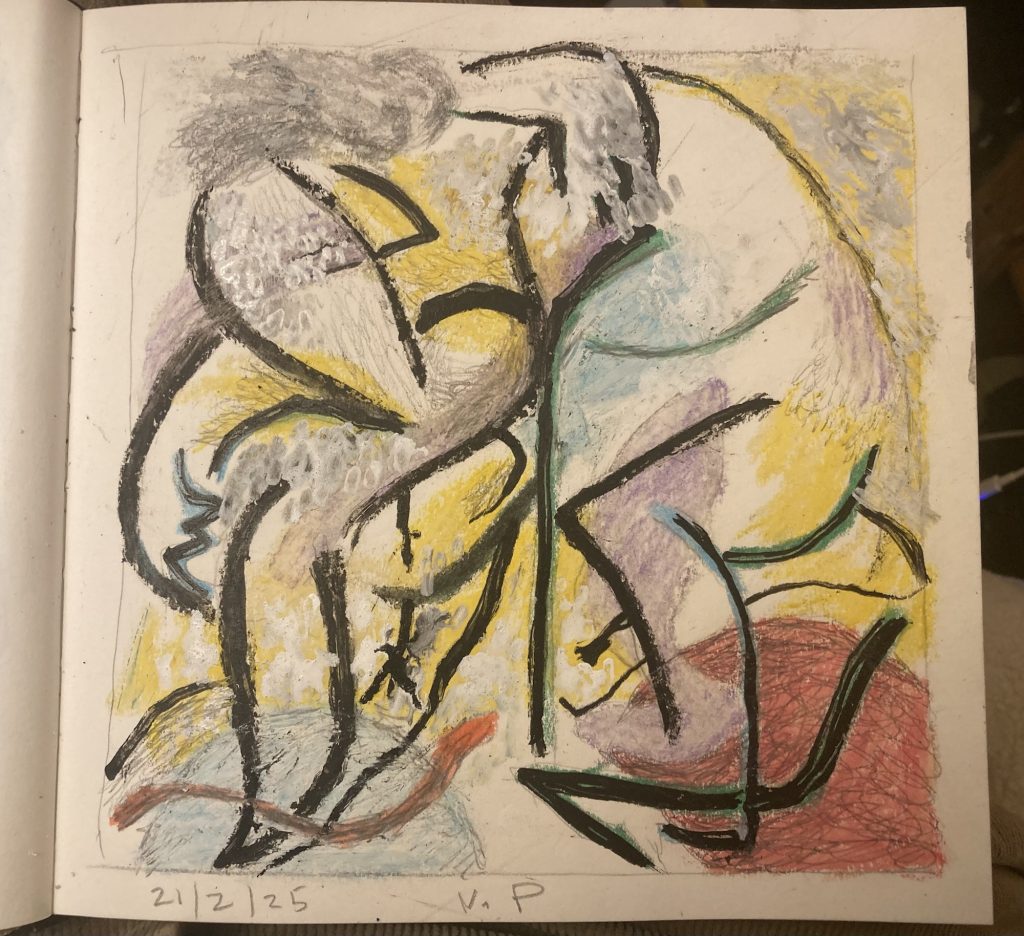
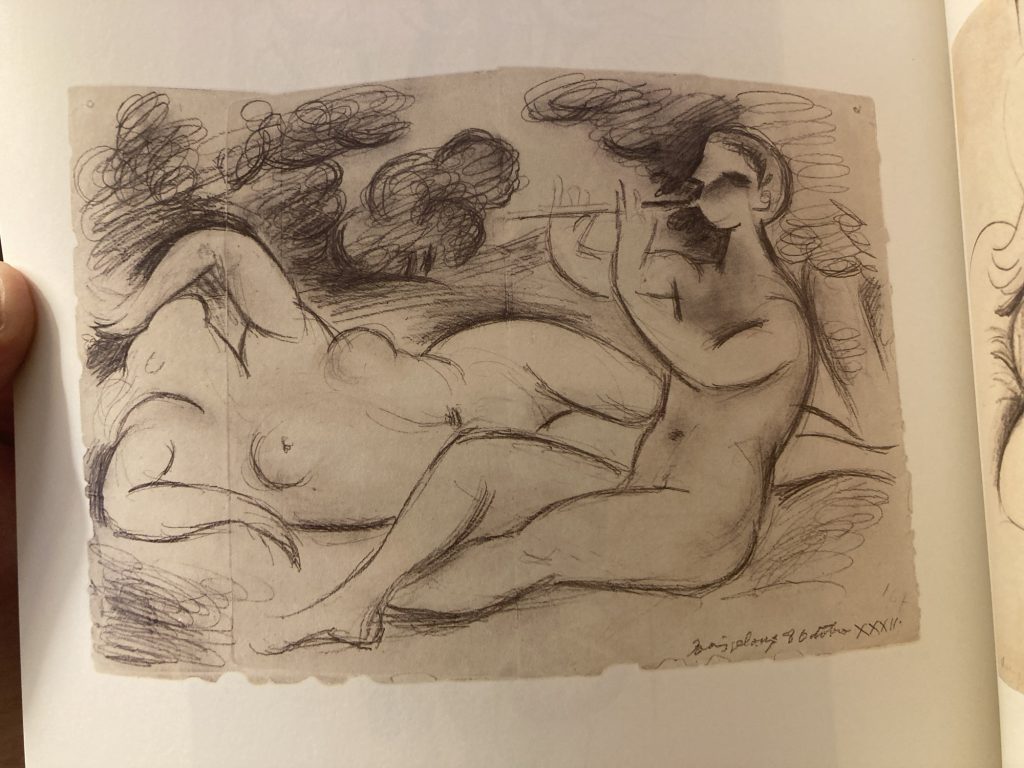
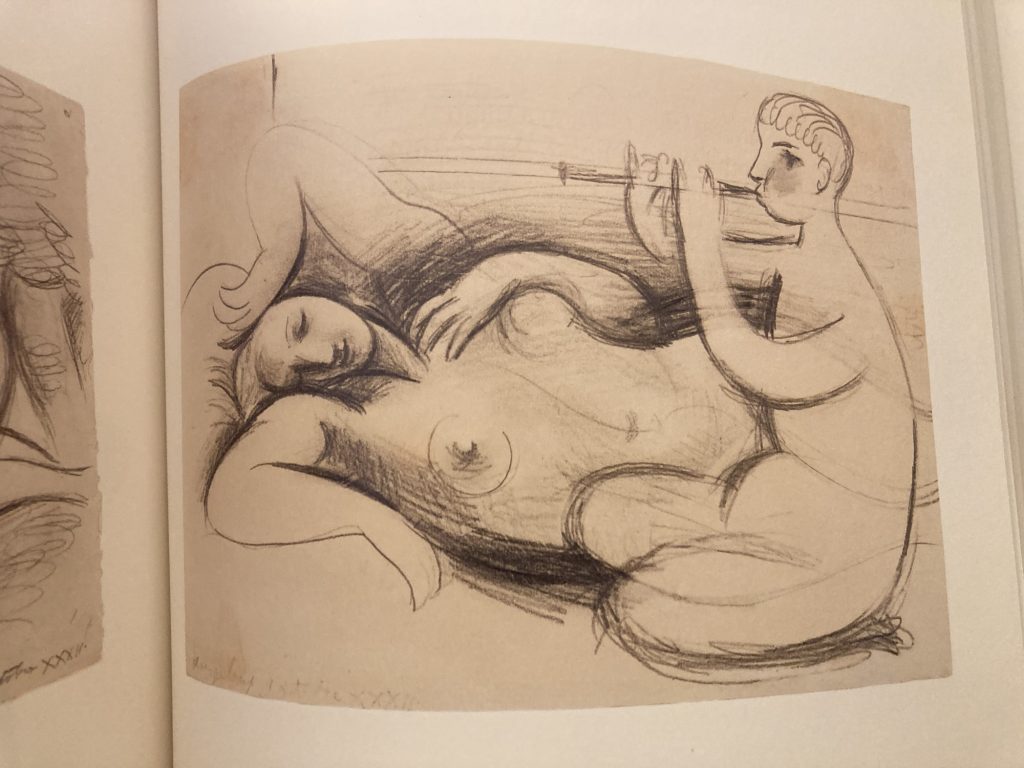
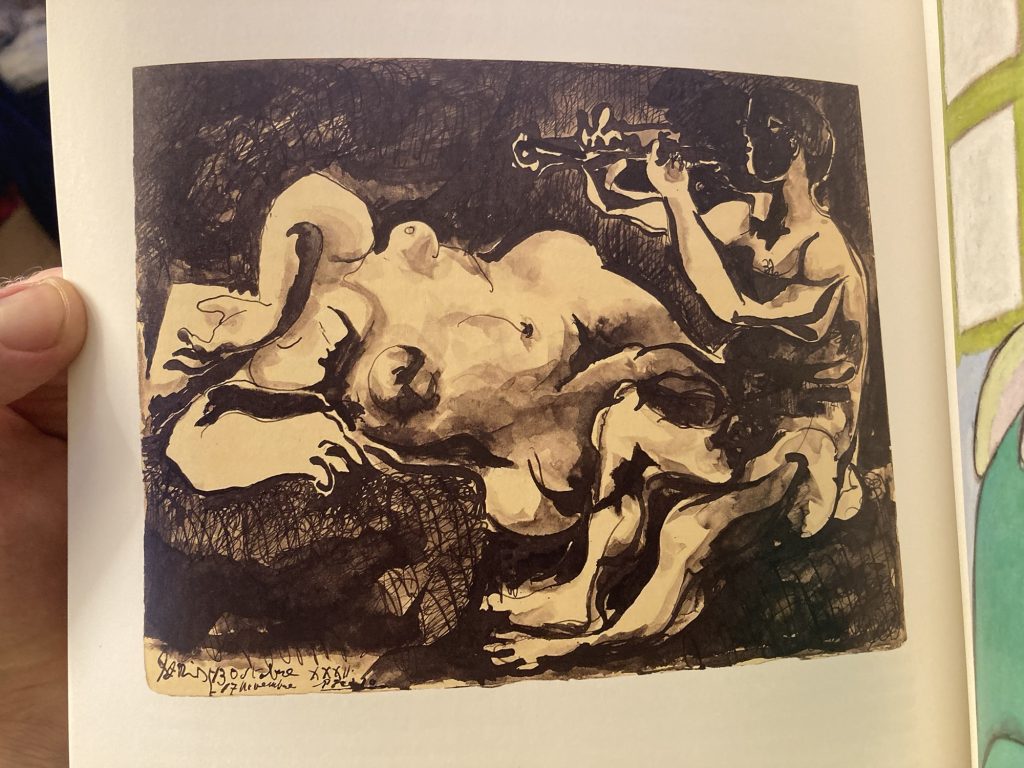
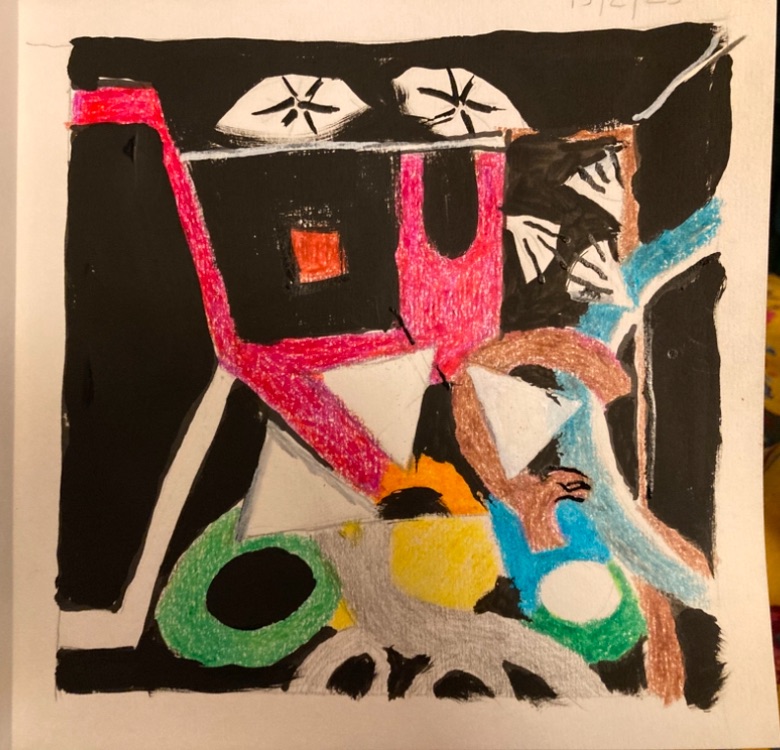
More Picasso mining… It’s funny how sometimes stuff just falls into place. And other times? Well, these two feel like ‘other times’.
I’ve felt pretty happy with almost all the recent artworks, up till these, today. I s’pose you can’t win ‘em all? And it’s okay to just plug away, sometimes.
Besides? These are studies, and works in progress. They might come good…
Having said that, the right hand one is pretty much done, I reckon?
Hmmm? Not really working.
Well, whatever… as folk say these days. They is what they am. And I’ll leave them as they is, for now. Mayhap I’ll grow to like ‘em? Or else I might work further on ‘em?
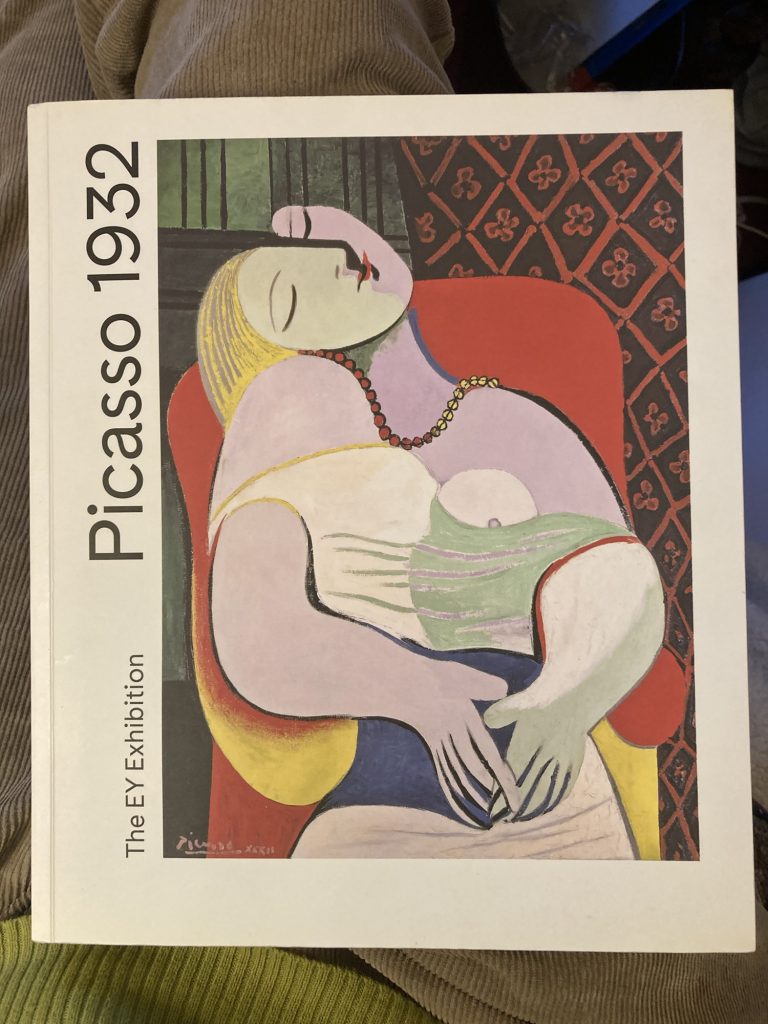
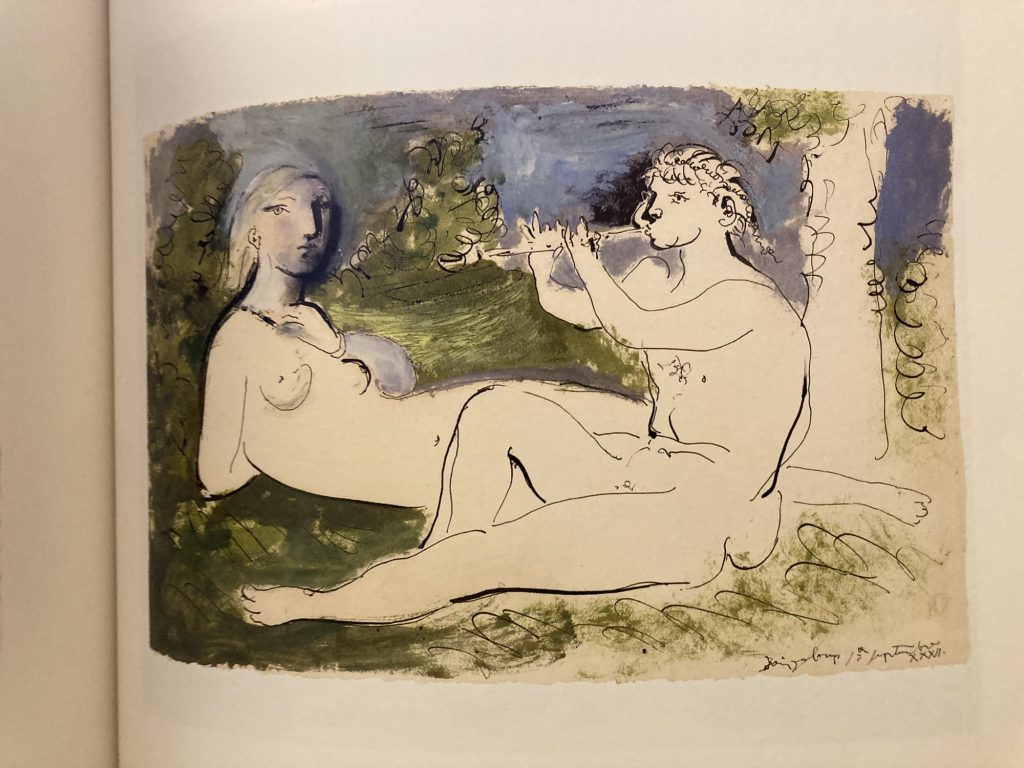
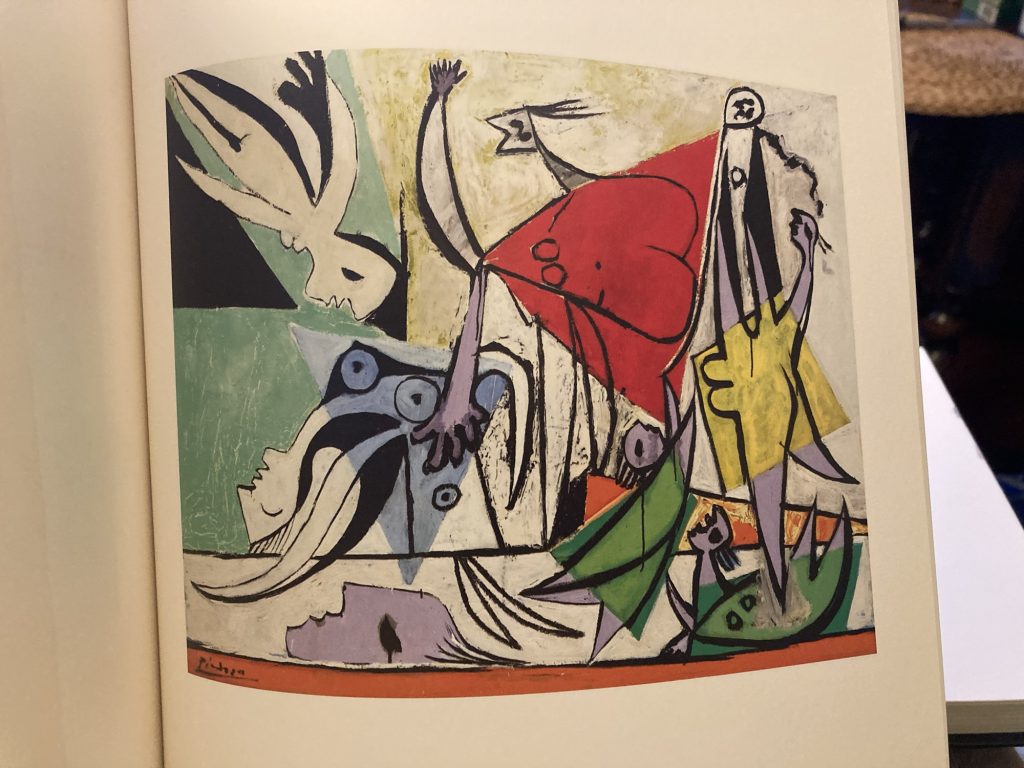
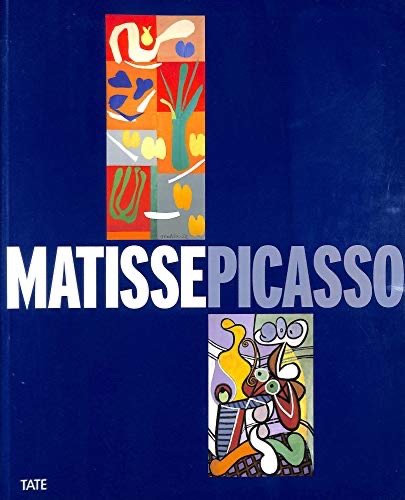
I thought I’d take a Picasso book with me to our pub brunch. So I took this smaller more portable one, above.
A conversation this morning, with my ol’ buddy, Dan Ellis, got me thinking I’d like to make him a piece of art. And gift it to him/them. I only hope I can do something they might actually like!
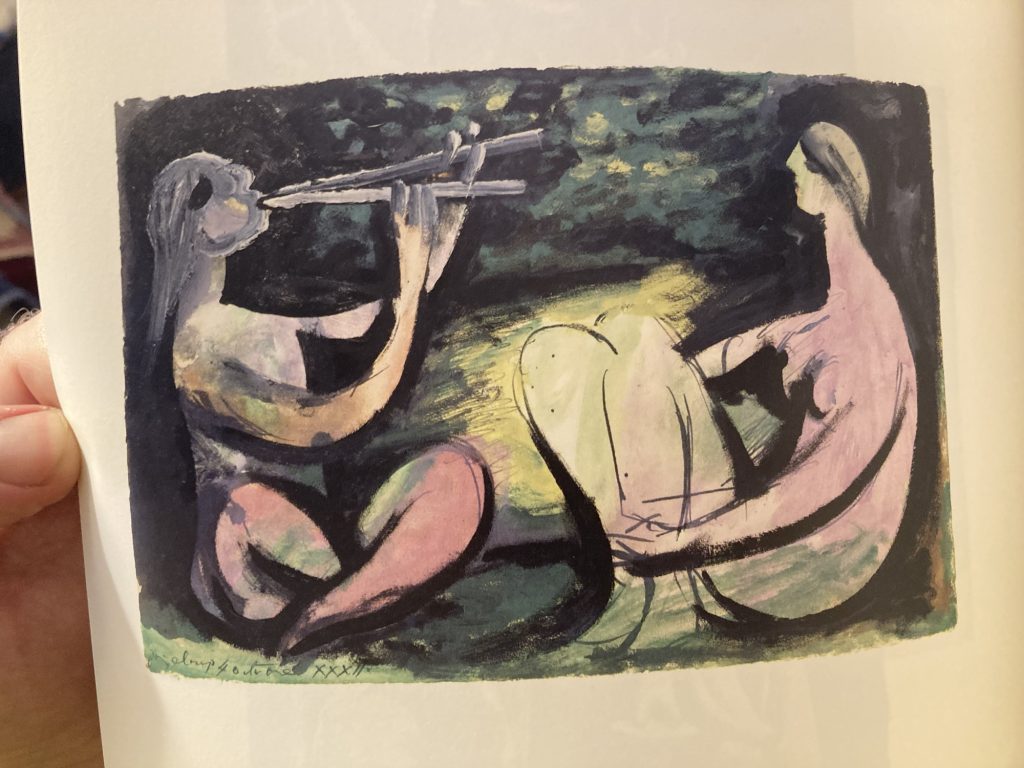
We gifted him/them a Japanese print, a while back. I’d wanted it to be a flute player. But I couldn’t find one! I’d like to a flautist avec his lady. And the above gallery is some kind of seam of inspiration for me.
Picasso’s prolific energy, the diverse range of his output… its staggering. Literally, to me at any rate, awe-inspiring.
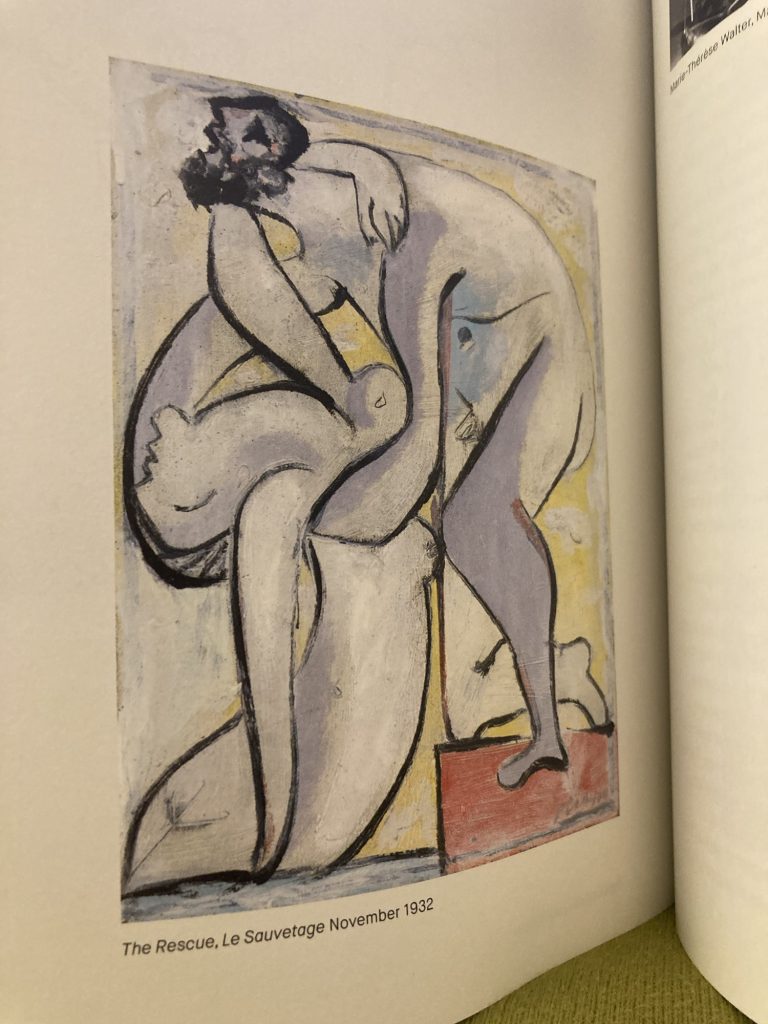
Strong lines, subtle colours.
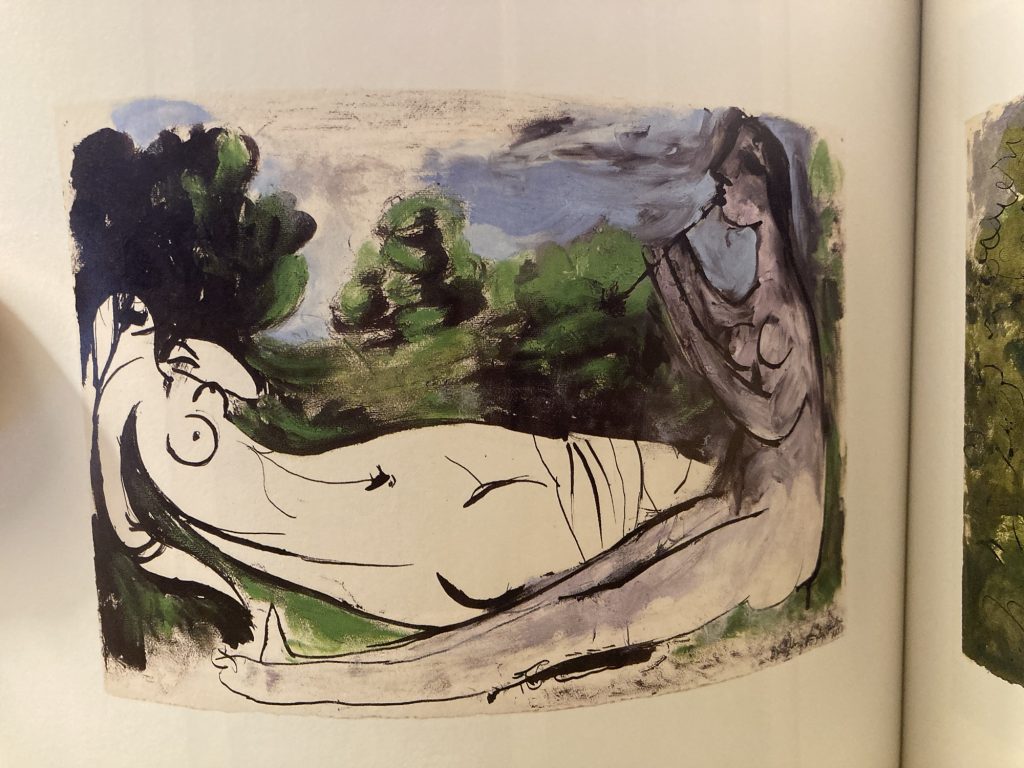
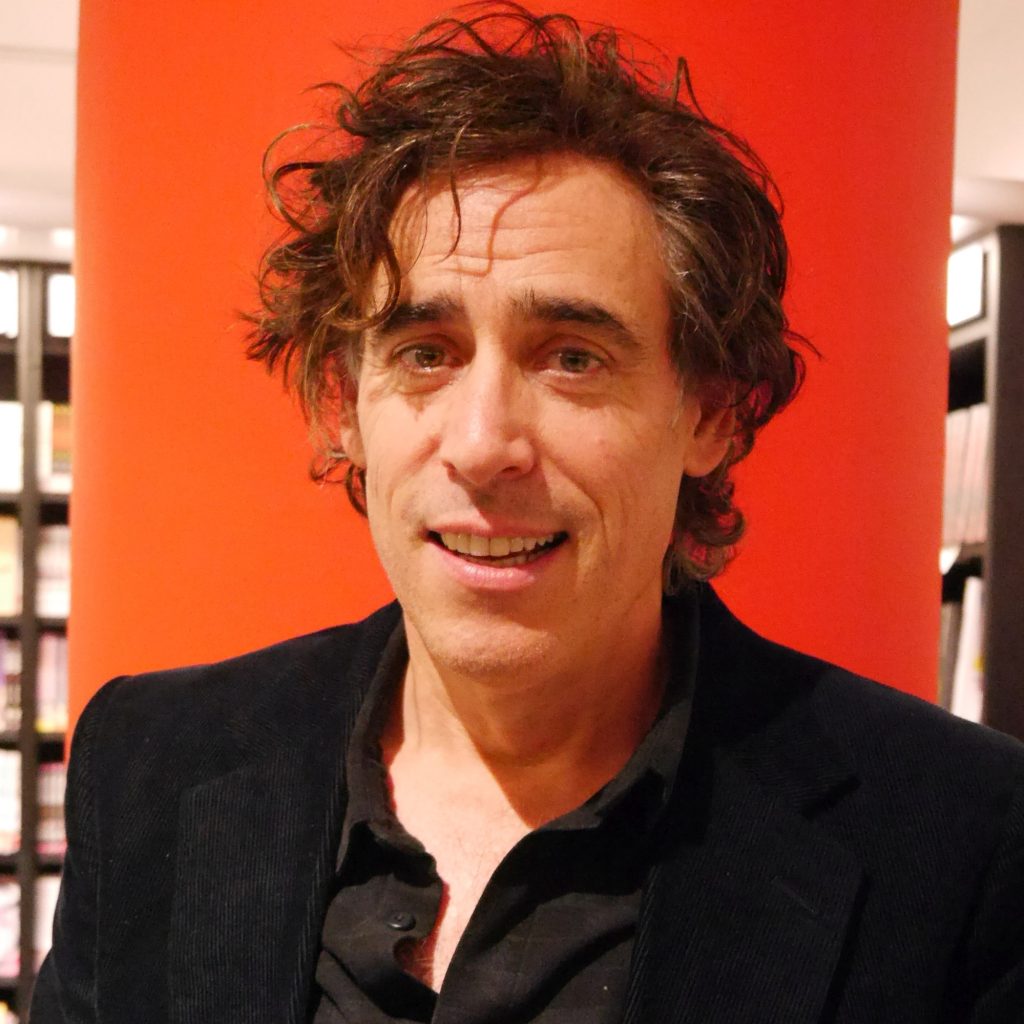
I include the above more for colours, and vibes, as opposed to subject or literal structural design. And I include the painting below simply because I utterly adore it.
Why, to me, is this amazing!?
Anyway, I hope Picasso will help me channel some artistic vibes, and come up with something Dan (& Amy) might like enough to put up on their walls…
So, to battle…
LATER…
Sketch #1, for Dan, via Picasso.
So, I’ve done a first sketch, of flautist and lady. I’ll now try working several versions up, in a variety of ways. I want warm but subtle colours, combined with bold simple lines. Let’s see what I can do…
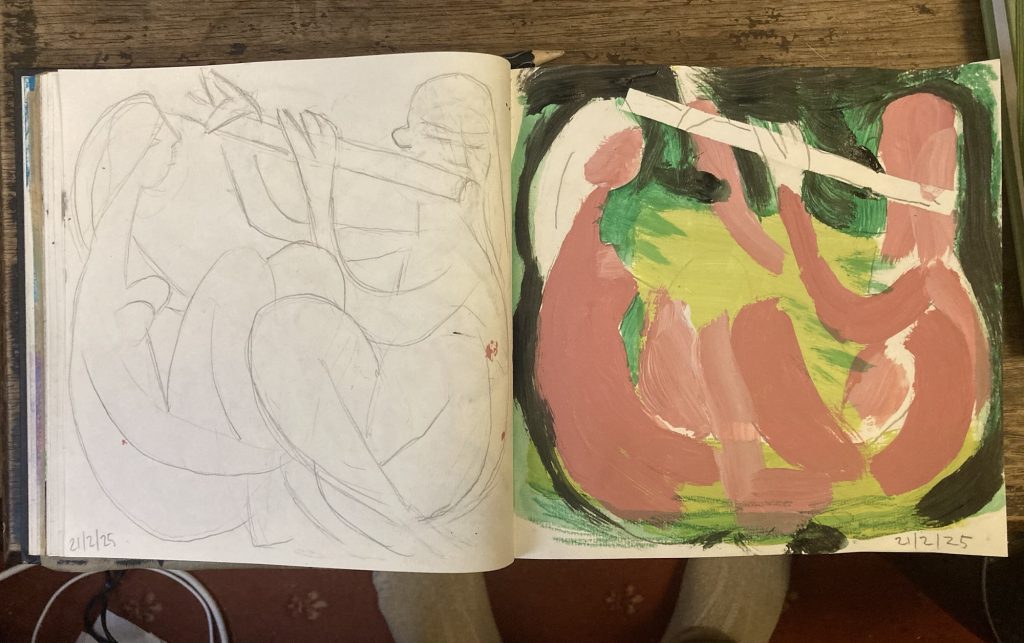
Initial sketch, left. Colour blocking, right.
Well, it’s the end of the day. Time for beddy-bye-bumpkins! And I’ve made some progress on the mooted Dan & Amy artwork. I’ve got a line drawing I’m happy with. And I’ve even started in on a colour version.
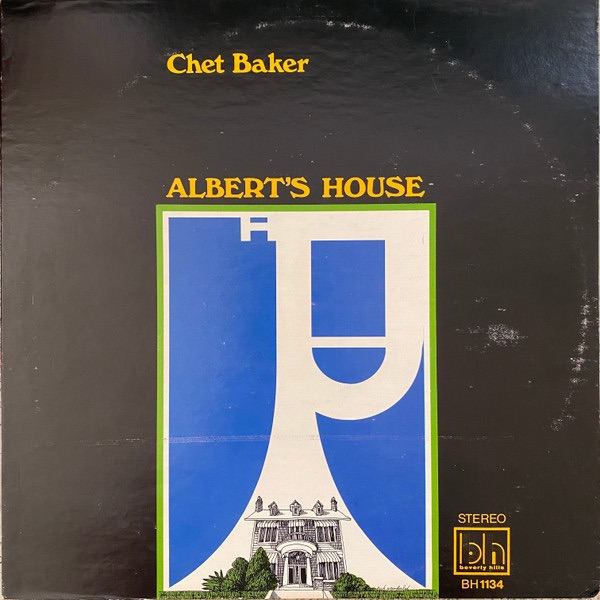
This is a very interesting album, in my opinion. Scott Yanow really pans it, on the allmusic.com website. I think he’s mistaken.
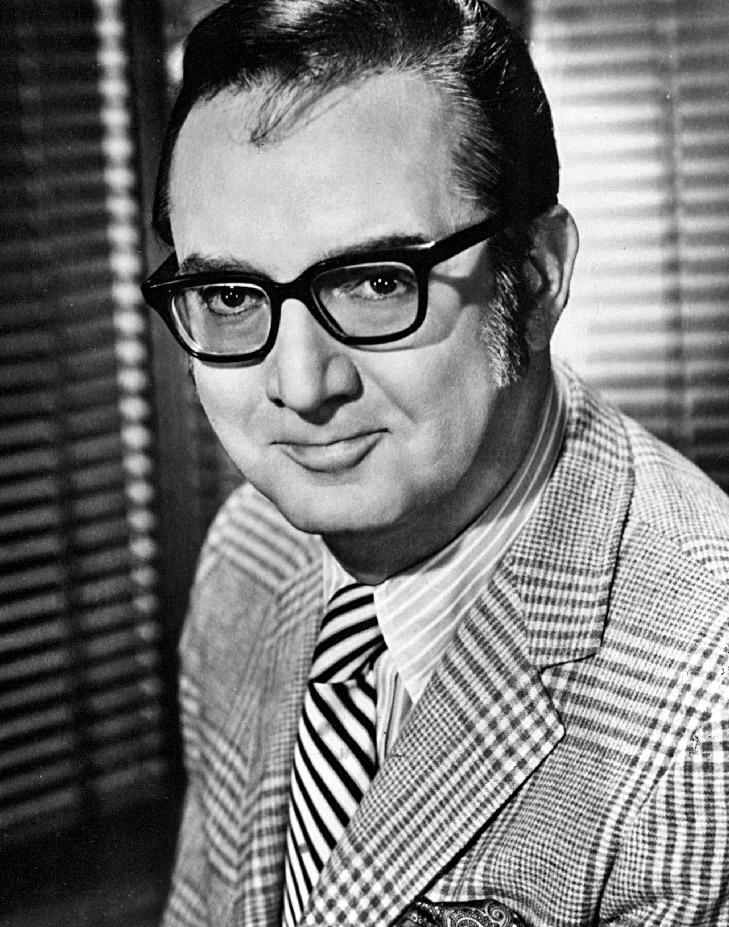
All the material is by Steve Allen, the famous TV talk host. He was a prolific composer. And here, he gets to have eleven of his compositions played by a stellar cast of jazz cats.
Steve Allen.
The circumstances that lead to this recording are fascinating. Chet, a notorious junkie, had been attacked by some underworld ne’erdowells. They targeted his mouth, knowing its importance to him, as a trumpet player and singer.
It’d be great to know more about the album’s genesis. Basically Steve Allen was helping Baker restart his musical career, after a traumatic event that could well have ended it. And for that reasons alone, it’s a really interesting musical document.
But it’s better than just a curio. The players are all top drawer jazzers: Paul Smith, on keys, is best known for his work with Ella Fitzgerald. Here, in addition to piano, he plays a rather unusual sounding organ, as well. The timbre of this instrument, which is all over most of the album, lends it a distinct and unusual feel.
Bassist Jim Hughart played with a huge number of big names. I first encountered him through his tenure with Tom Waits, in the latter’s earlier jazzier beatnik phase. And then there’s guitarist Barney Kessel, a six string artist of great ability, who plays in a very understated manner on these recordings.
And on drums, we have Frank Capp. As with the other ‘residents of Albert’s House’, Capp’s resume is a who’s who of famous jazzers. So the supporting cast are uniformly top notch.
It is true that Baker himself isn’t sounding at his tip top best here. But it’s not as bad as Yanow makes out. In fact the liner notes for these recordings refer to Baker’s ‘restrained’ readings. Outlining the melodies, and taking it pretty easy solo wise.
The notes put a rather odd gloss on this, as being only right and proper, due to the unfamiliar repertoire! I guess it wasn’t thought apt to spill the beans on the shadier and much sadder truth?
But this slice of Allen’s compositional repertoire is another reason this album ain’t as bad as some make out. I’d rather listen to these very mellow and rather cosy recordings, for example, than to the album Chet Baker Introduces Johnny Pace, in which – whilst everything’s much more polished and familiar – what we get is basically a Sinatra knock-off.
Wow! Gotta get/hear this…
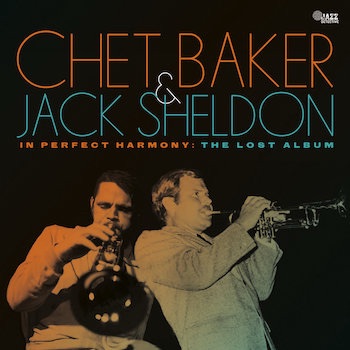
Whilst researching this post, I discovered the above. A recent (2024) release of a never before available 1972 recording of Baker and Jack Sheldon (who, like Hughart, and even Barney Kessel, recorded with Tom Waits). Read more about this here.
FOOTNOTE
The story I first heard about Chet getting beat up is his own version, as given in the movie Let’s Get Lost. But this interesting piece, with a reference to the movie Rashomon, suggests the truth might be more murky and complex. As several folk in Let’s Get Lost say, Chet liked to milk his stories for effect/sympathy!
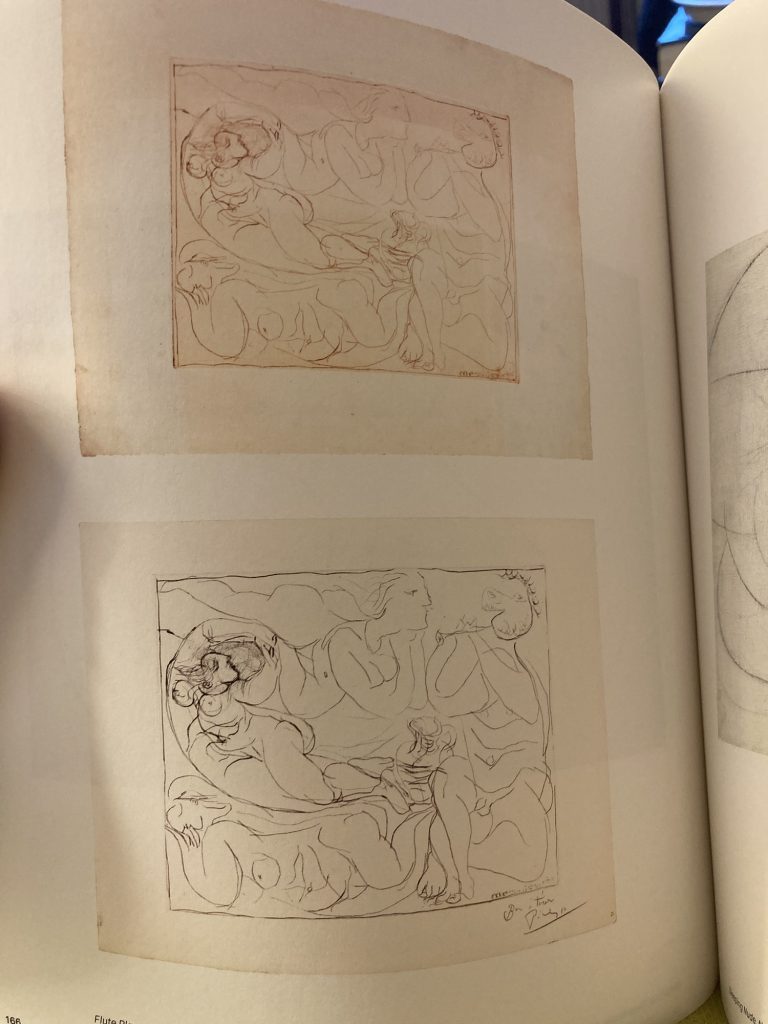
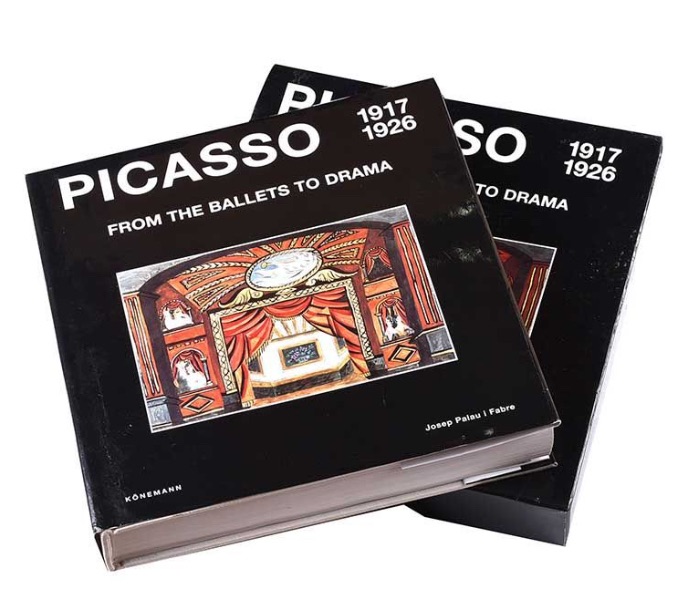
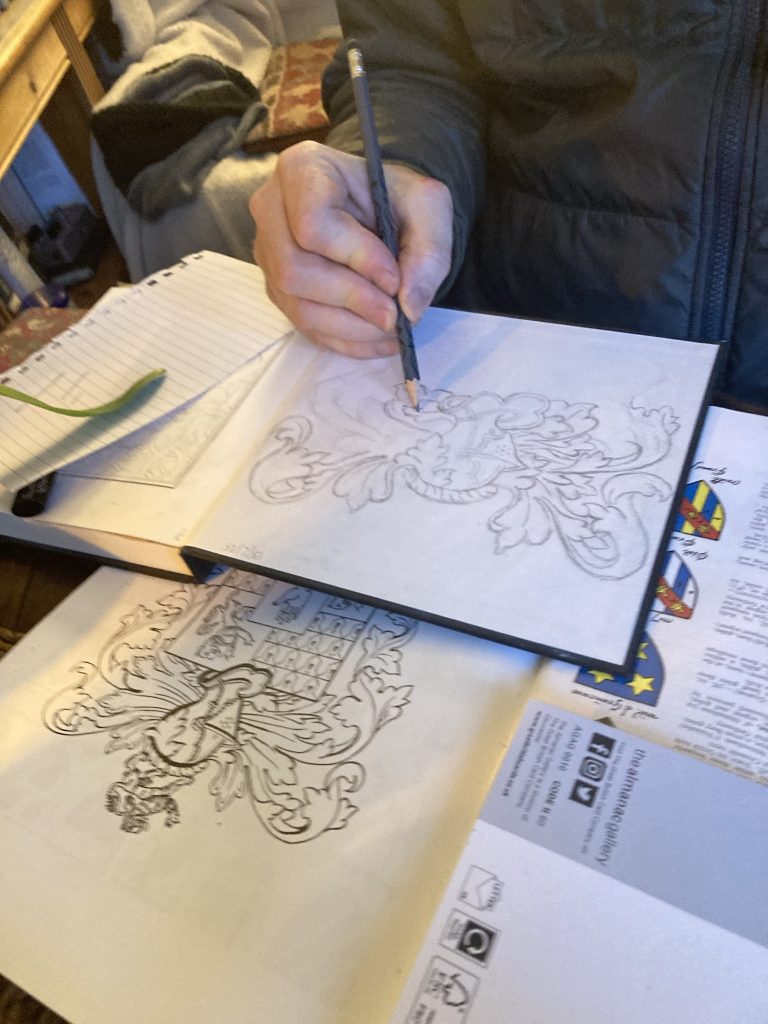
Last night, having done no art during the day, I sketched out a couple of ‘via Picasso’ pencil drawings. Drawing inspiration from Josep Palau i Fabre’s third large volume on Pablo:
I don’t have the slip-case, alas.
This is my most recently acquired in this suite of very large and very lovely tomes. And it’s the one I’m least familiar with, contents wise. So I thought I’d have a butcher’s…
I quite like to draw upon (boom boom!) almost any old image. I will select some and reject others. But often the ones I pick aren’t those I necessarily like the best. They just appear, to me, to have something I could learn from. Quite what, I’m not always sure.
Earlier phase…Two on the go…
As can be seen, from this and previous posts, I’m maximising the use of the sketch pad, by working both pages. I need to spay-fix the resulting artworks, to minimise them printing onto each other.
Sometimes I’ll just work on one. At others I might work on both. Mostly I’ll concentrate on one at a time. I’m still using mixed media. And I’m finding that enjoyable and satisfactory for what are, to me, preparatory or exploratory sketches.
For some reason, for me, Picasso, with his volcanic outpourings of creativity, is a go to seam of inspiration. I can mine in the many chambers of his creative catacombs, and never fear I’ll run out of exciting ideas.
I even find it intriguing that he might have certain popular recurrent themes – bull fighting, theatre and the commedia dell’arte all spring to mind – that I’m not that fussed about myself. I can still milk these strands for ideas.
Again…
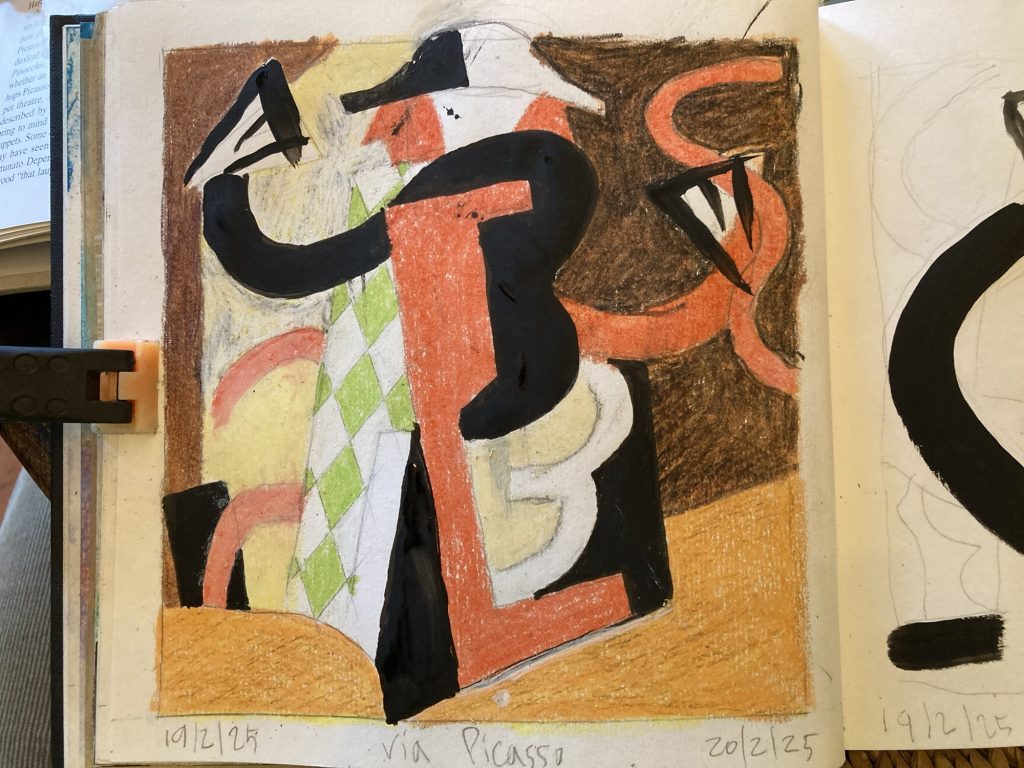
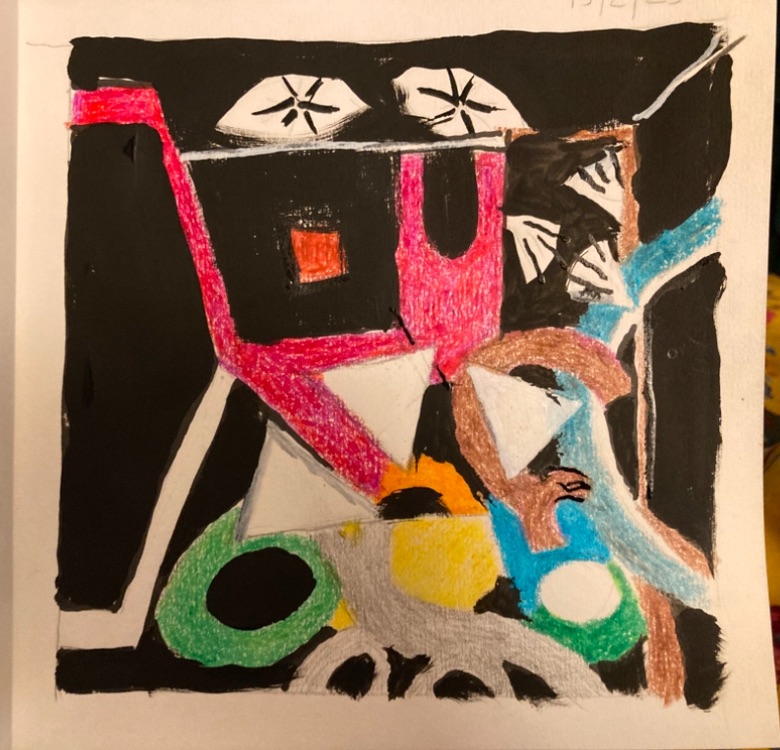
I reproduce the current WIP, above (exactly as it is at the top of the post), again… so as to have it in view whilst reflecting on it. I’m reading it – in my version – as a figure with an inverted guitar in a brown room, against a door opening.
There are elements of symmetry, balance, or ‘echoes’, some drawn from Picasso’s work, and some that I’ve introduced myself. I can tell that I want to ‘abstractify’ the whole thing a lot more. And probably soften some of Picasso’s harder angles/planes.
Picasso likes things that double up – a bike seat and handle bars become a bull’s head, for example – and here a figures’ body is also that of a guitar. The Harlequin references – the diamond pattern and funny (admirals?) hat – are retained in my version. But I think I’ll work them into something less obvious.
Today’s art works…
Started working a bit more on the second piece.
Actually quite like this…
Much to my surprise, I actually quite like where the second piece is headed. Once again, it’s a combination of Picasso, and my own stuff. Whilst mining Picasso, I do have to make these things my own.
I started using some cheap gouache paints, that I got from WHSmith, in Peterboro’. They turned out to be a bit more translucent/transparent than I had imagined they would be. But that’s not proving to be a problem, so far…
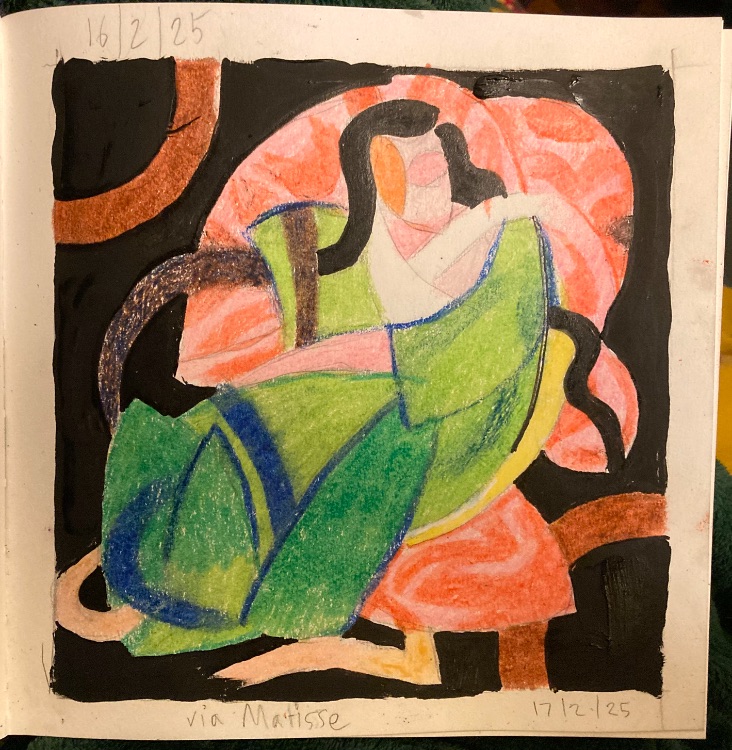
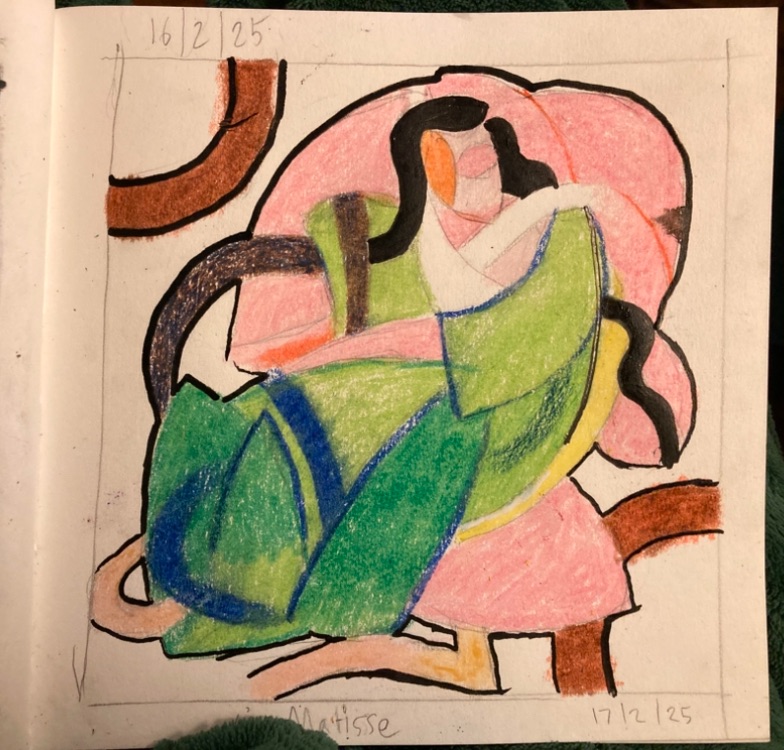
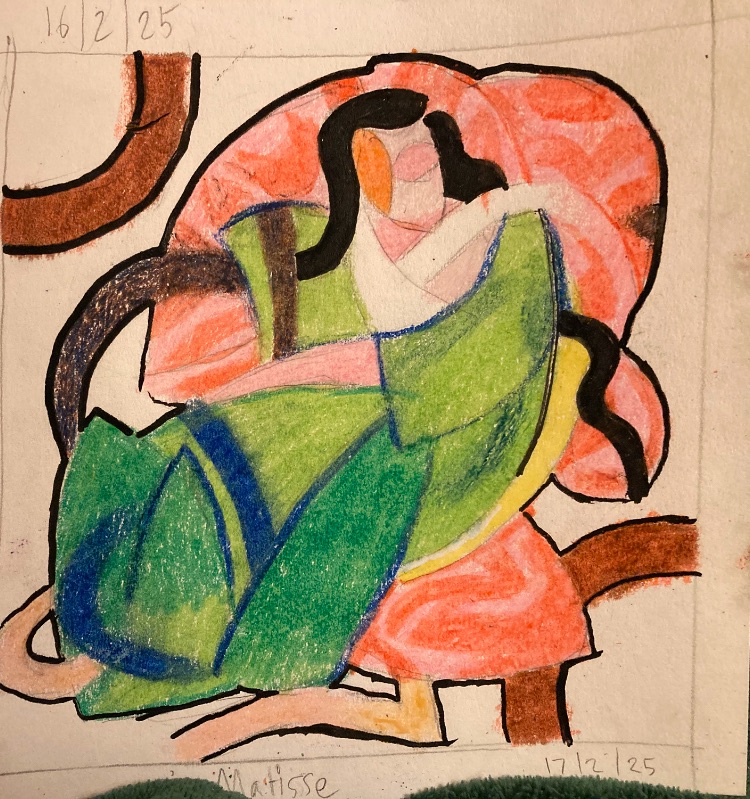
After quite a productive weekend, Art wise, today saw a bit of a slow down. I sketched this one (above) last night, in bed. And I coloured it today. Or rather this evening. Once again, in bed!
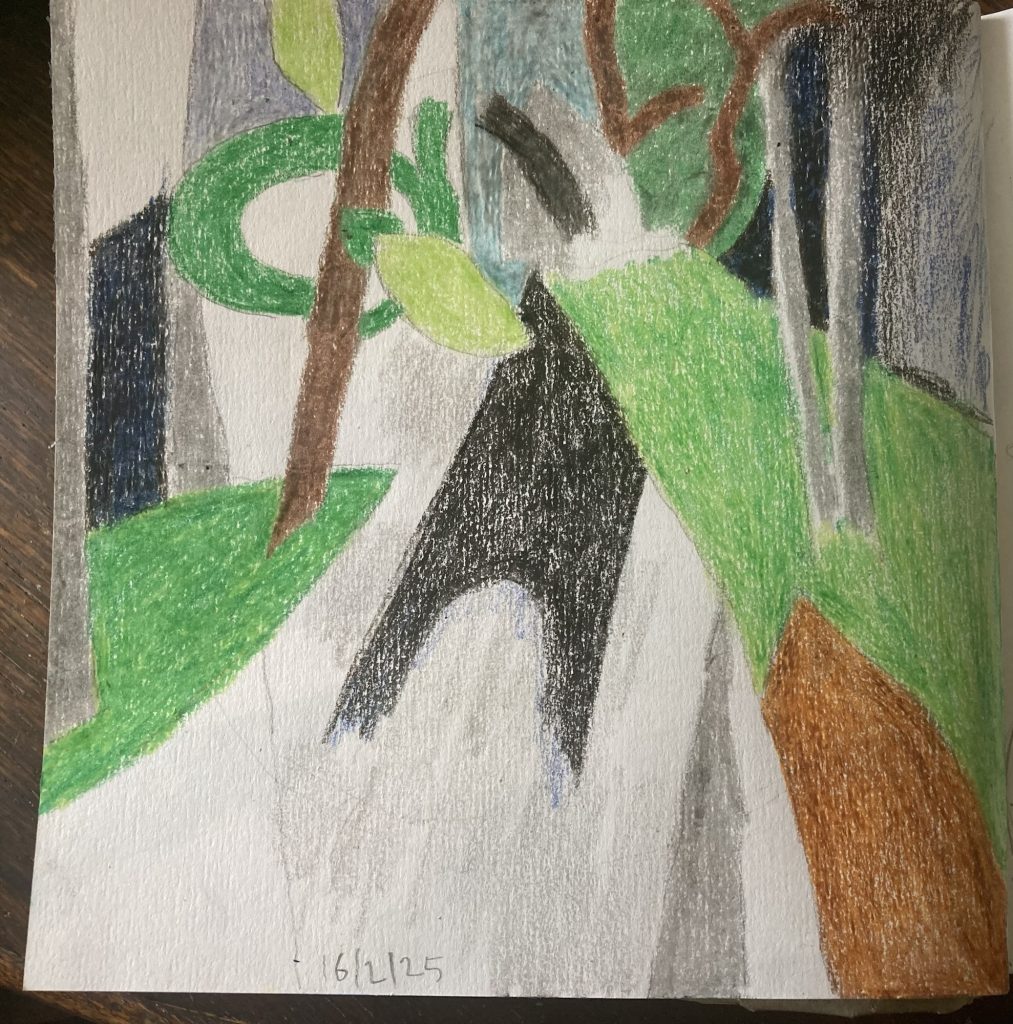
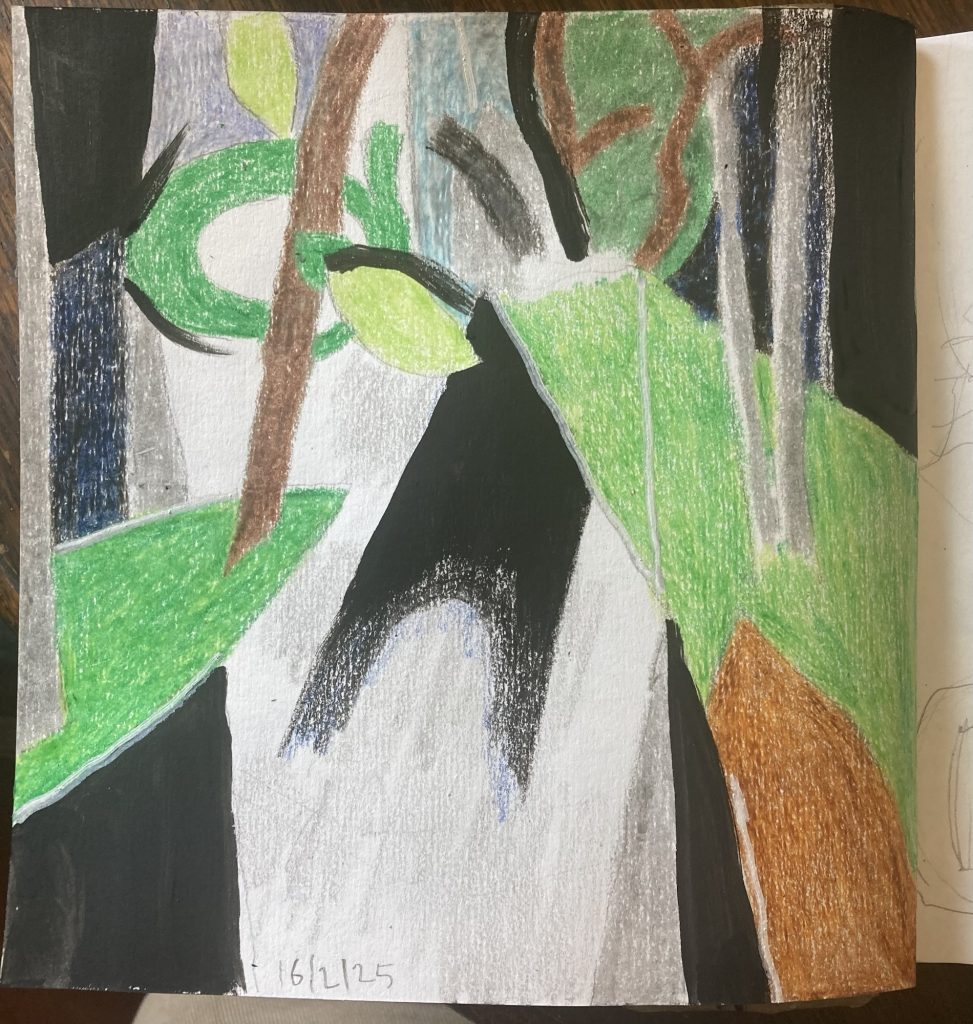
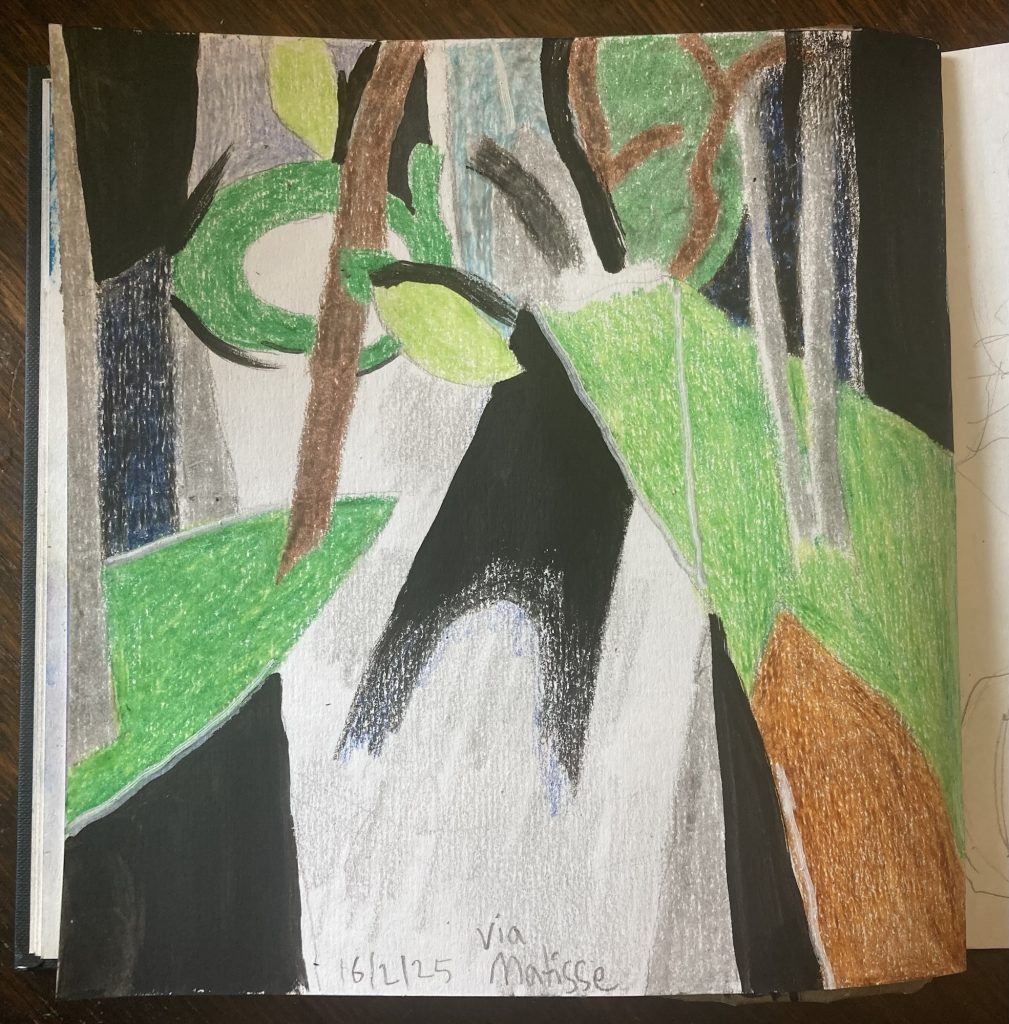
Yet another ‘via Matisse’, from the above book, which is one of several I bought from the wonderful Black Gull Books, in St Leonards, during our holiday there last year.
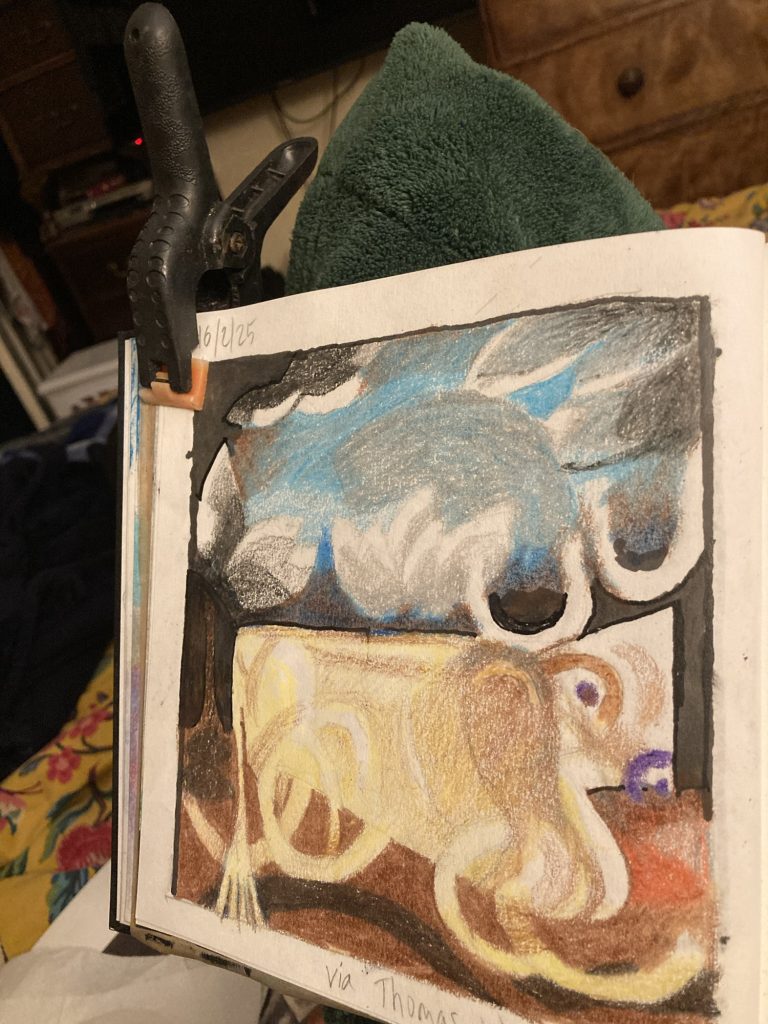
In progress……
I feel this one is more like a sketch ‘along the way’, if you like? I’m taking a work by Matisse, and trying to extract something from it I can turn into something of my own. And it’s not there yet.
Note clamp, holding other pages.
I like using the woodworking clamp, as pictured above, to keep the sketchbook under control, whilst I work on the opposite page.
I’ve gotten into the habit of using both sides of every page. Given how expensive art materials have become – they’ve always been expensive, and are now getting to be insanely so – this gives more mileage.
Up until now, I’ve been almost rabidly enthusiastic about Picasso. And I’ve had little or no time for Matisse. Picasso’s often more brutal, sometimes even downright ugly work, always bowled me over, with its sheer raw energy. I felt Matisse was too slick. More designer than artist, perhaps?
This Tate book, however, juxtaposing as it does, the work of these two modern masters, has taught me, at long last, to really love Matisse. It’s opened my eyes to his work, in all honesty. He’s certainly more overtly and obviously sensual and seductive than Picasso.
What previously seemed a little odiously smooth, has started to look, very simply put, plain gorgeous. For all the parallels and similarities – and this book/show/curatorial theme highlights how close they were in many ways – there is also a striking difference.
I could waffle on about all of this here. But I haven’t even read any of the book, which most likely addresses such issues. As with most art books, I’m here for the imagery, not the text. I’ll leave further cogitation for another time/place.
Well, it feels like the cork is off, and, um… to quote Count Arthur Strong (I think?), ‘the genius is out of the bottle.’
That may sound fatuous and vain. But you know what? Fuck it! I’ve had more than my fill of, up to this point, being timid and negative, and running myself down.
Via Velazquez/Picasso.
I recently heard – and very much enjoyed – Stephen Mangan, on BBC R4’s Desert Island Dicks. He came across extremely well, to my way of seeing and hearing things.
Amongst many other strands, all talked about with a very winning combination of humility, frankness, and both melancholy and joie de vivre, he mentioned succeeding as an actor in the US.
Stephen Mangan.
He talked about how the very clichéd British type of diffidence – with which I’ve always been appallingly afflicted (modesty, false or real) – will see you sink like a stone, out in the Wild West.
I’ve been a total twat, many a time. And I’ve pumped out crap of all sorts, from the literal stuff to the verbal kind, to the ‘creative’. But right now I’m determined to accord my creativity a greater degree of respect.
Via Matisse.
Partly on account of all the suffering I’ve been through; be that physical ailments or mental anguish. Be it self-inflicted, inherited, nature, nurture, whatever. Whether I’m a total pussy, or a psychic warrior, I giveth not an shit.
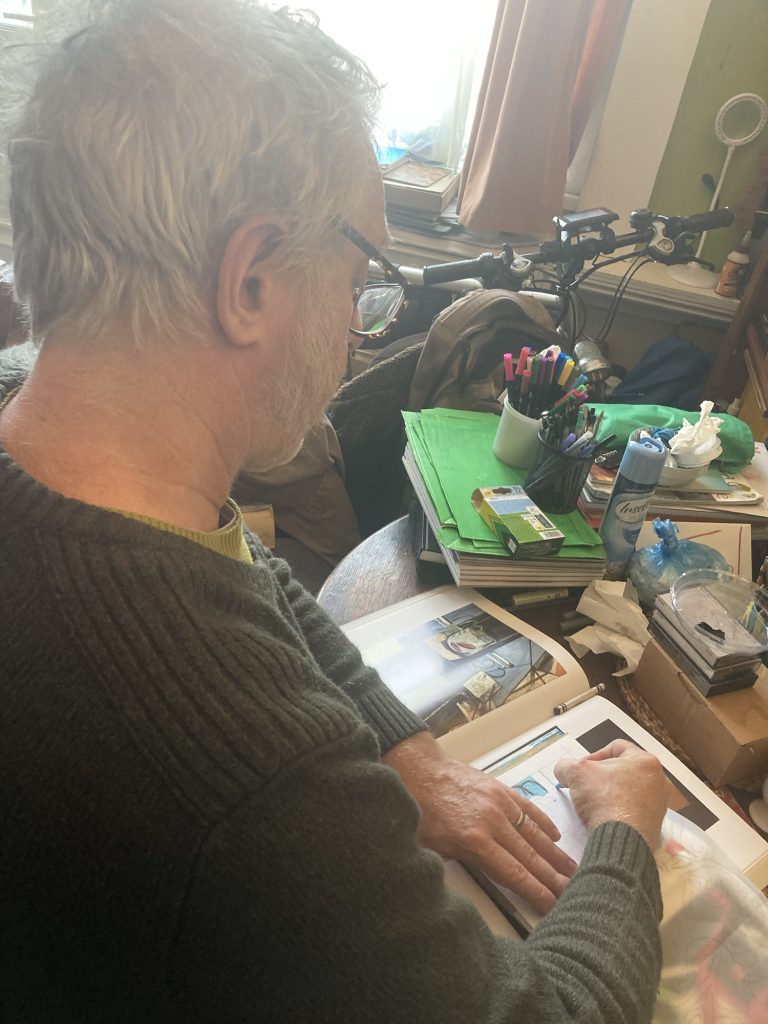
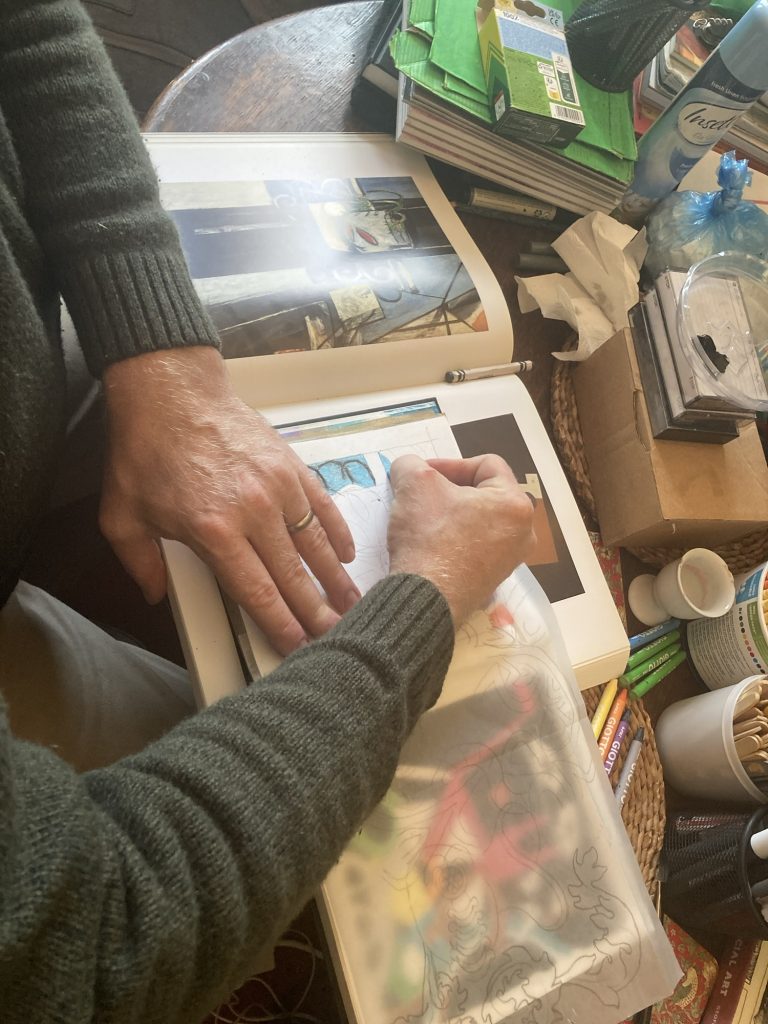
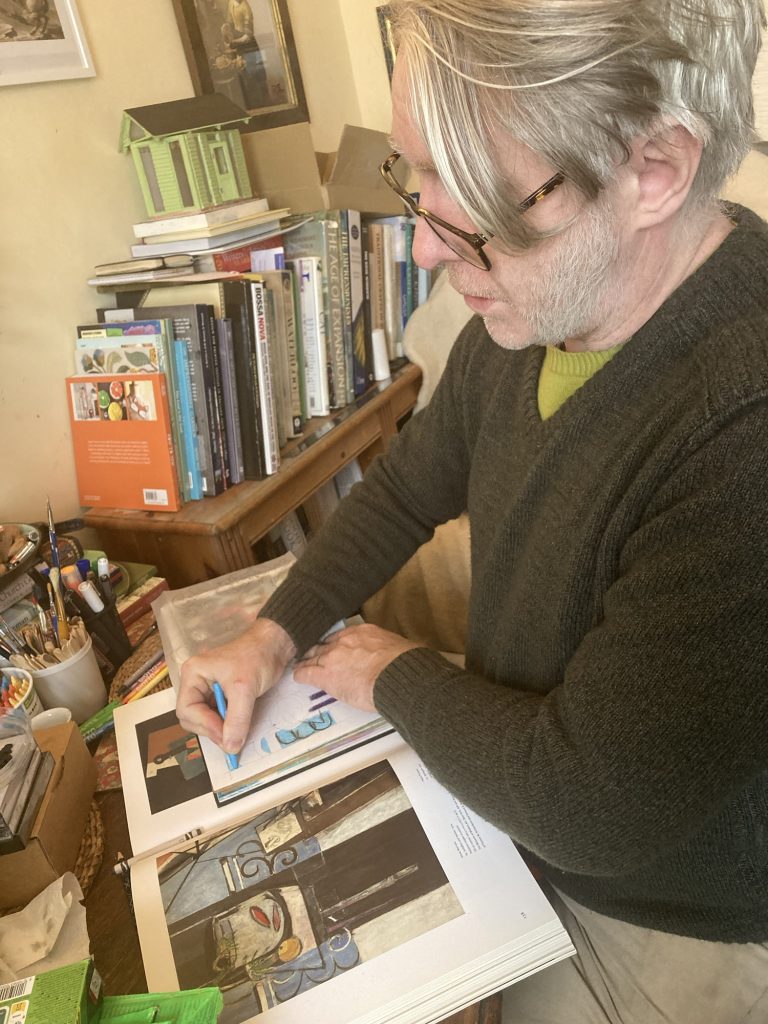
Teresa’s taken a few snaps of me at work recently. It’s nice for her, as well as me, to see me getting back into creativity. Hopefully she’ll start doing (more) art as well? She does lots of creative arty stuff at work. But I’m talking about her own personal ‘fine art’.
A few days ago…Today…
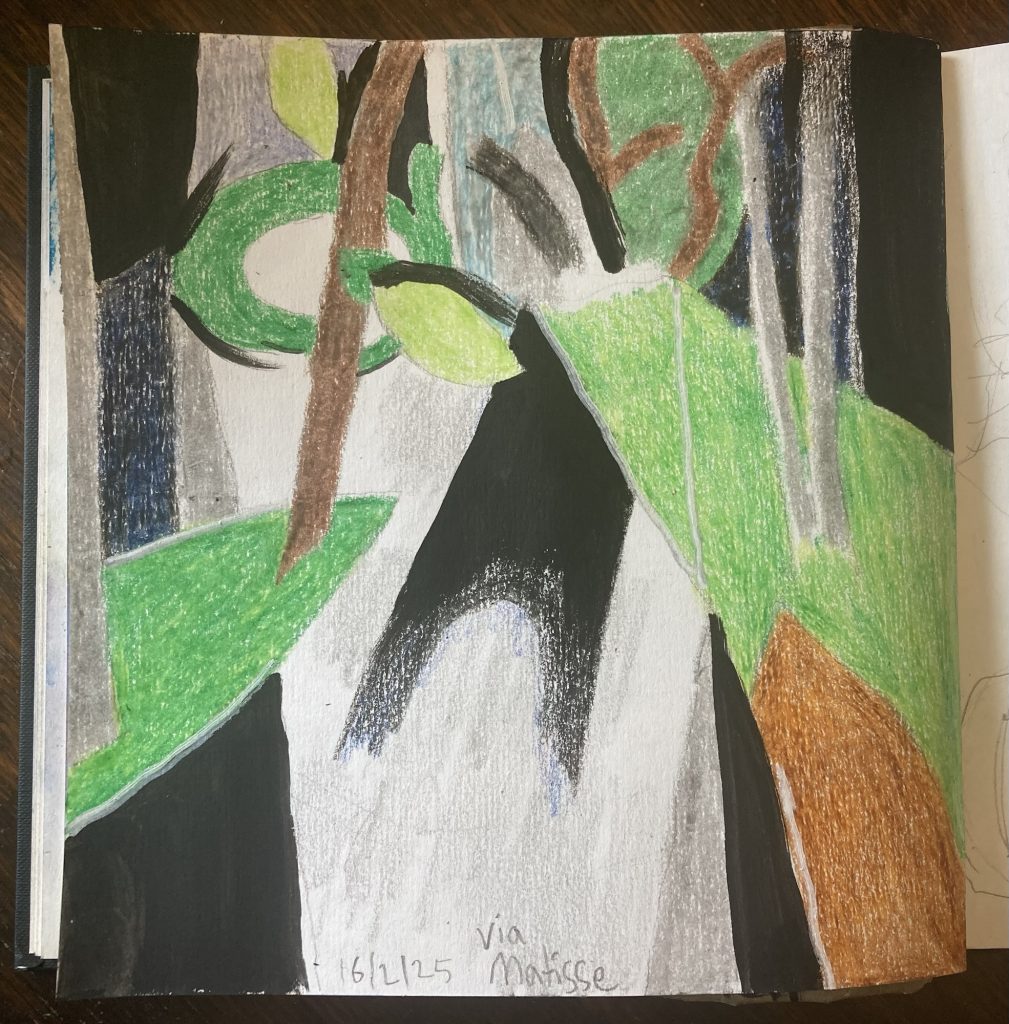
And here’s another, ‘via Matisse’, from earlier today:
Via Matisse.
Studying the greats is always good practice. Copy, borrow, steal… learn what there is to be learned from them.
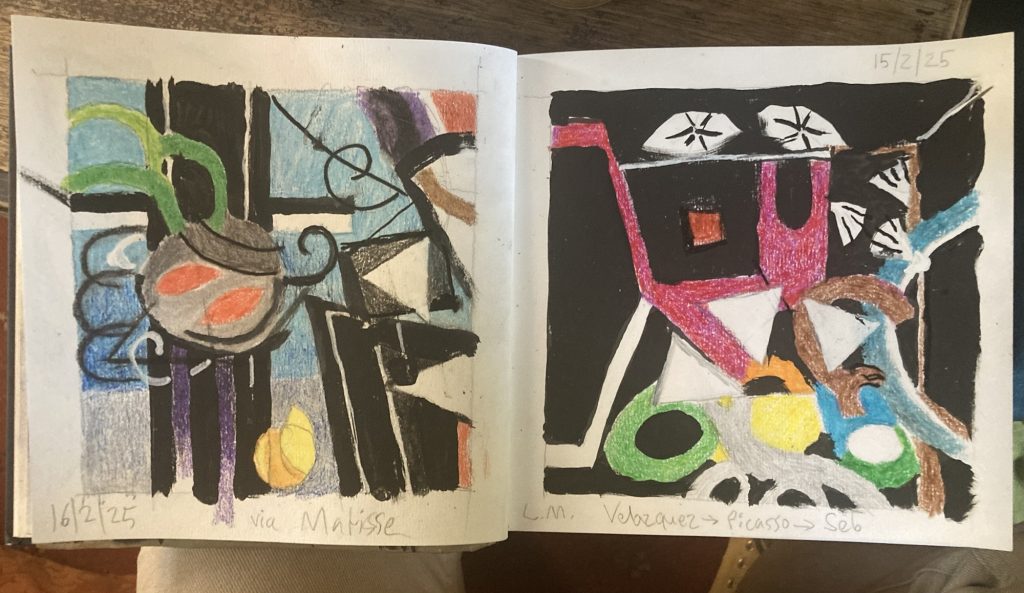
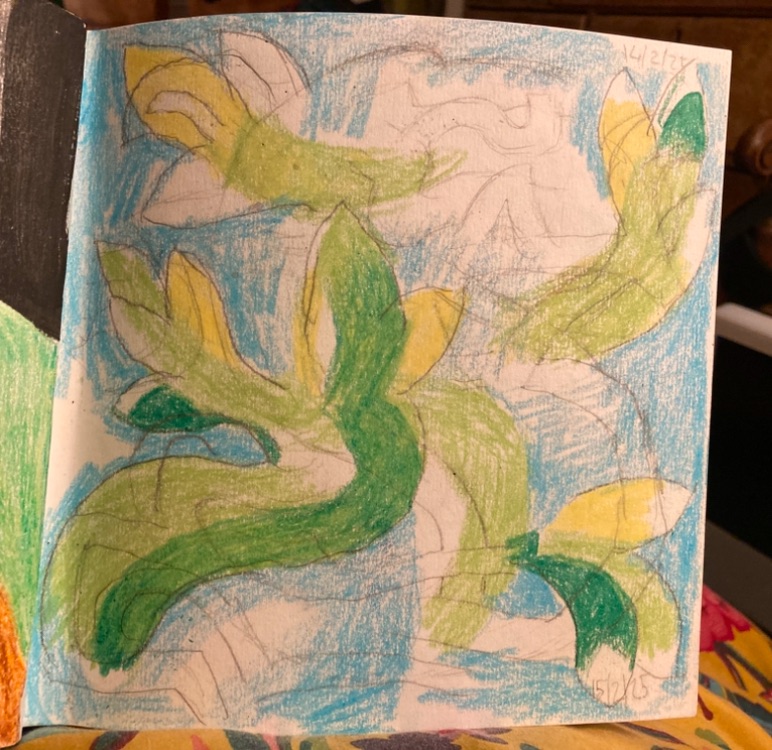
For me, out of the three artworks of mine featured in the above portion of this post, the via Velazquez/Picasso is the best, or most promising. The other two, both via Matisse, show some promise. But they aren’t quite there, yet.
LATER
Some time later… a couple more from today:
A ‘background’ study.
My little sketchpads, which are ages old (and have some drawings in them going back well over a decade), are starting to fill up. And the content is quite varied.
From pencil sketch copies of heraldic stuff, to ‘background studies’, to copies of stuff by The Masters (old and new), and original stuff. In pencil, pen, pastel (oil and chalk), with acrylic, and all sorts.
And, to my great surprise and gratification, there are threads in all of this stuff that run way, way, way back, to my teens, in terms of ideas, approaches, motifs, techniques, and so on. My ‘crisis of artistic identity’ seems, to me right now, to be resolving itself.
Prime beef…
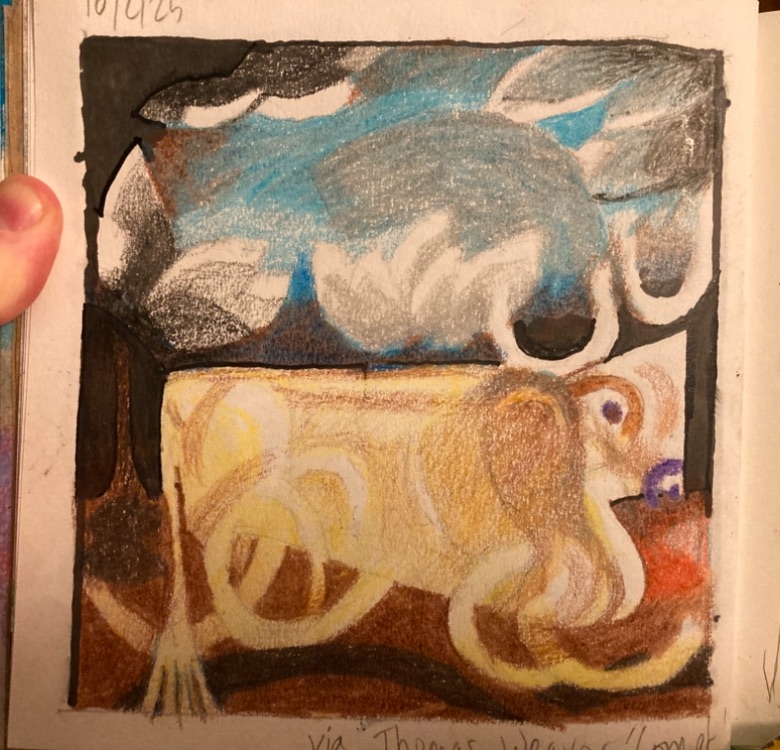
I like the above picture. Based on a Thomas Weaver painting of a cow, or bull, called ‘Comet’! I think I’ll do a series in this line, maybe called ‘Prime Cuts o’ Beef’? I think the bovine itself needs a bit more abstractifying…
I also like, sometimes, to take pictures at various stages of execution, such as this little gallery:
… because sometimes I might prefer an earlier stage to the ‘completed’ end product. With the above, for example, I quite like the first, which has more white and less black in the overall composition.
I’ve decided – not for the first time – to stop using Facebook.
Why? For several reasons. First, I waste a lot of time on FB, trawling through stuff I’m not really that interested in. And second, and most fundamentally, the way FB is run, and who by.
The amount of toxic crap FB showers me with… it’s just not something – like advertising generally (and especially gambling advertising) – I want to expose myself to.
I need to discipline myself to focus on things that will keep me happy and healthy, and help support me as a creator, not just a zombie consumer.
The Z.
As billionaires go, Zuckerberg seems more enlightened than most. But I think, along with some others, that such obscene wealth – concentrated in the hands of just one person – in the world as it currently is, should not be allowed.
Somebody – ironically on FB, I think? – said such folk should receive some kind of ‘congrats, you won the game of Capitalism’ type medal, or award, and have the bulk of their wealth redistributed for the benefit of the many.
Not only is such concentration of wealth obscene and immoral. It’s incredibly dangerous. Money is power in our current world. And such wealth gives certain individuals ridiculous leverage.
What Elon Musk is up to, right now in the US, in cahoots with the orange sock puppet, Trump, is extremely worrying. Gutting government in order to essentially privatise and make corporate the running of one of the worlds’ most powerful and dangerous powers.
Anyway, in an attempt to live a better live, FB… adieu.
I can’t believe it… I’m making art, and enjoying it. This is getting on for a first, in absolutely donkey’s years.
It’s not just that I’m doing it at all. That in itself is something. It’s that I feel as if everything up to this point is somehow coalescing, in a good and meaningful way.
Velazquez > Picasso > Me.
I’m no longer fretting about my diverse magpie strands of interest. I literally seem to have shed that complicated sense of impostership, to mint a new word.
I’m happy to take whatever I’m interested in – which is very varied – draw on it (note artsy pun), and then synthesise and filter it. Or should that be vice versa?
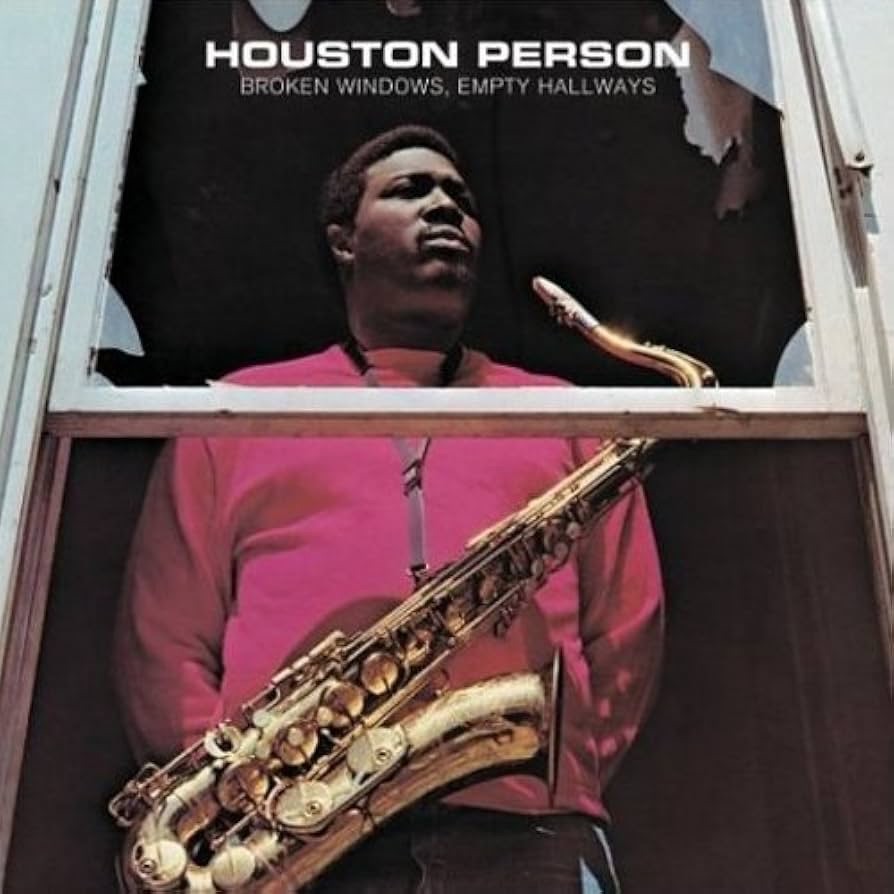
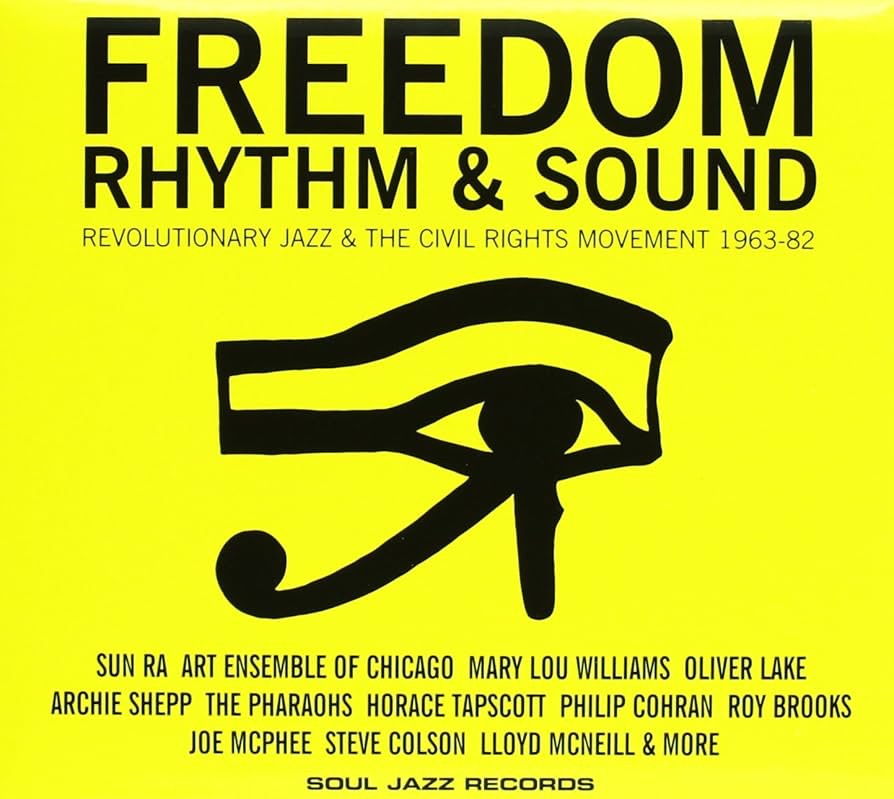
A couple of CDs plopped through the letterbox this morning:
These two new arrivals run the gamut from massively and happily more than I’d hoped for, and ‘oops, wrong item!’
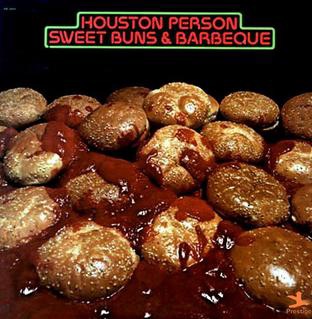
The Houston Person disc went straight into the CD player, in Flo’. And, to my surprise and delight, it turned out to contain both of Person’s last two Prestige recordings, Broken Windows, Empty Hallways, and Sweet Buns & Barbeque. Both from ‘72, the year of my own ‘release’.
Mmm…
I thought I’d only got Broken Windows, Empty Hallways, andthat I still needed to find a CD re-ish of Sweet Buns & Barbeque. But no, they’re both on this one CD… result-o-rama!!!
I’m hoping the Freedom CD will be good, as well. But there was some disappointment on opening the parcel, as I thought I’d ordered the Soul Jazz book, not the CD. So I still want/need to get the book…
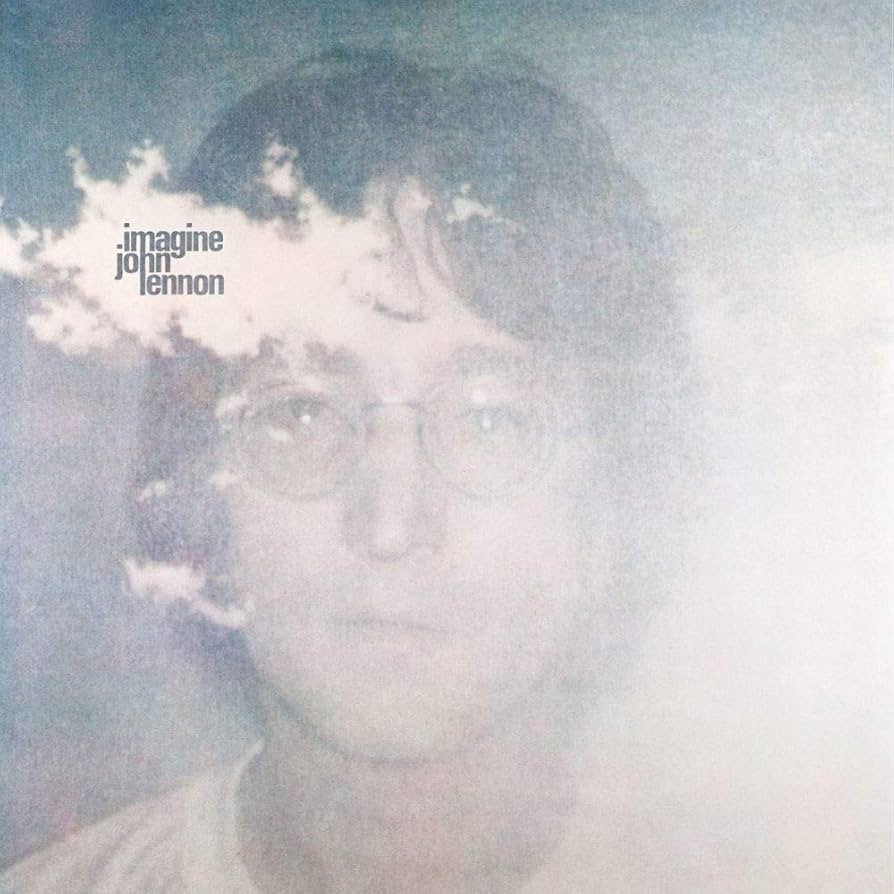
Houston Person does an instrumental version of John Lennon’s ‘Imagine’, on Broken Windows, Empty Hallways. And that got me thinking about how, whilst I have most of The Beatles’ albums on CD, I have almost nothing by any of them post-Beatles.
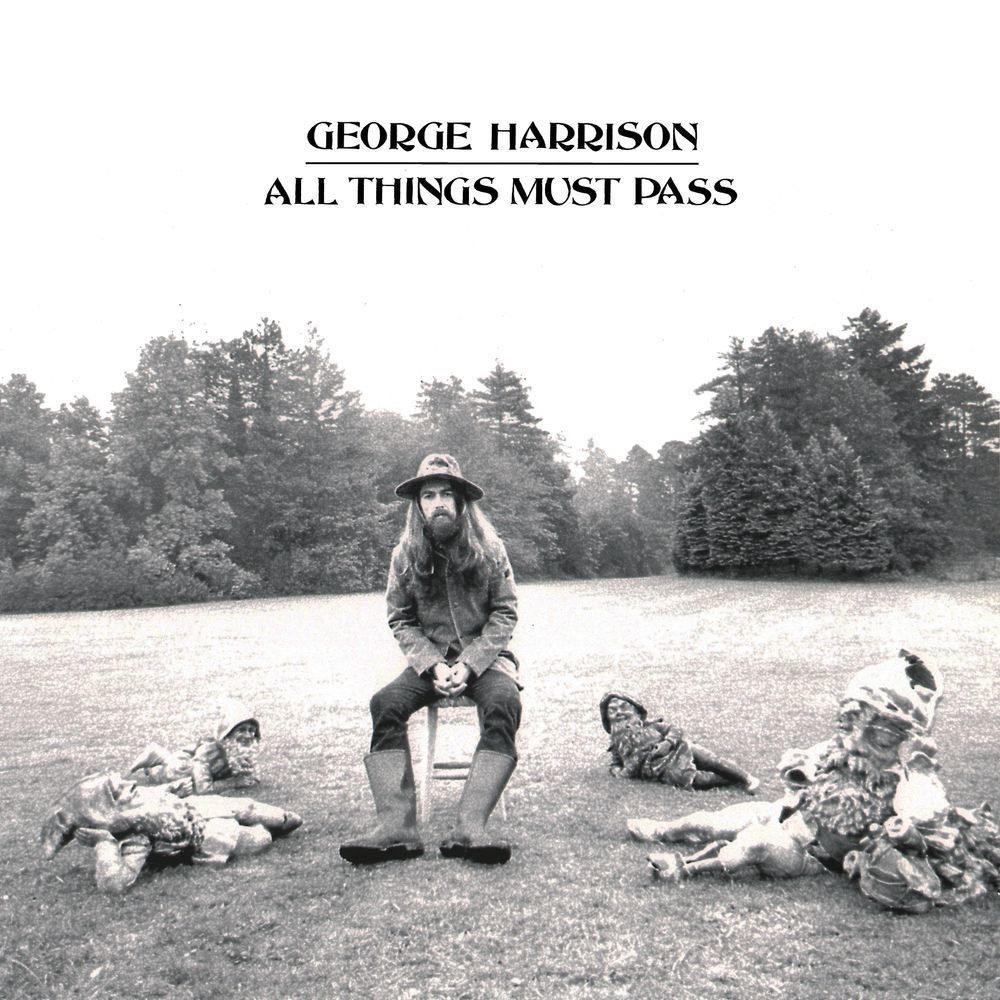
I do have George Harrison’s All Things Must Pass, and Wings’ Band On The Run. But that’s it. No Lennon, nor any non-Wings solo McCartney. I must remedy this!
I must admit, All Things Must Pass, is, to my ears, distinctly underwhelming. and then there’s the solo stuff by Ringo. His first post-Beatles album, Sentimental Journey was universally panned. And his next, Beaucoups of Blues, is a country and Western record!
But back to Houston Person, and co. This single CD reissue of his last two Prestige recordings is great. A real treat. A stellar cast of sidemen, with such luminaries as Grady Tate, Bernard Purdie and Ron Carter, amongst others, really deliver.
In the seventies, and even right up to the present, many soi-disant jazz purists (moldy figs!) sneered at the way jazz of that period returned, somewhat, to one its many roots, inasmuch as repertoire is often culled from popular songs of the day.
I don’t mind that at all. Although of course it depends what the songs are, and how they are treated. And the arrangements here are great fun. There are elements of pop, easy-listening, and even TV or movie soundtrack. Making for a rich yet funkily jazzy whole.